
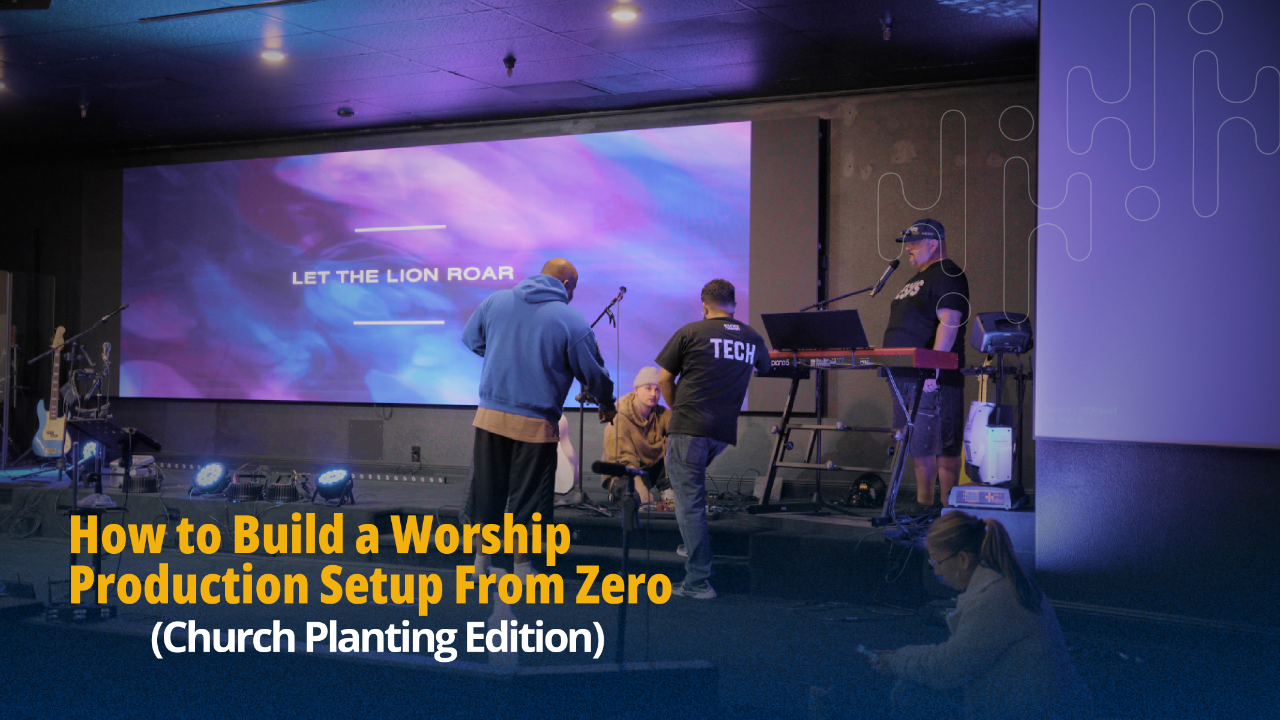
How to Build a Worship Production Setup From Zero: Church Planting Edition
Jun 22, 2026You just signed the lease on your first space. The walls are bare. The room is empty. And somewhere between the excitement of this new chapter and the weight of everything still left to do, it hits you.
You have no production setup. No sound system. No lighting. No cameras. Nothing.
And Sunday is coming. This is the moment most church planters feel completely alone. Nobody in seminary prepared you for this. Your church planting network gave you frameworks for discipleship and leadership. But nobody handed you a guide for building a worship production setup from zero.
That's exactly what this article is.
Whether you're launching in a school auditorium, a rented warehouse, or a permanent building you just acquired, this guide gives you a clear, practical path forward. Step by step. In plain language.
What Does a Worship Production Setup Actually Include?
Think of it in four layers. Each layer builds on the one before it.
Layer 1: Audio: This is your sound system. Microphones, speakers, monitors, mixing console, and all the cabling that connects them. Audio is the foundation of every worship environment. Everything else sits on top of it.
Layer 2: Lighting: This is how your room feels. Stage lighting that highlights your worship team. House lighting that creates atmosphere for the congregation. Lighting controllers that let your team adjust the room in real time during service.
Layer 3: Video: This is how your service is captured and broadcast. Cameras, a video switcher, and an encoder that sends your signal to your livestream platform or in-room screens.
Layer 4: Display: This is where your congregation sees content. Projection screens, monitors, or an LED wall that shows lyrics, sermon slides, and live camera feeds during service.
These four layers work together as one connected system. A weakness in any layer affects the whole experience.
That's what AVL integration is about. Audio, video, and lighting designed to function as one complete worship production setup rather than four separate purchases that may or may not work well together.
For a deeper explanation of how this all fits together, start here: What Is a Worship Production System? A Complete Guide for Churches.
What Should You Set Up First in a Worship Production Setup? (The Right Order Matters)
Here's the right order. And why it matters.
-
Start with audio. No exceptions
Your congregation will forgive imperfect lighting. They will forgive a simple stage. They will not forgive not being able to hear clearly. Poor audio is the fastest way to lose a first-time visitor and frustrate your regular attenders.
Get your sound system right first. Clear, balanced audio is the single most important investment you will make in your worship environment.
-
Then build your lighting
Once your audio is solid, lighting is your next priority. A well-lit stage tells your congregation that this space was intentionally prepared. It directs attention where it belongs. It creates an atmosphere that supports worship rather than working against it.
Basic stage lighting and the ability to control your house lights will transform how your room feels without requiring a massive budget.
-
Then add video
With audio and lighting in place, bring in your cameras and video system. Start simple. One or two cameras your volunteers can confidently operate. A basic switcher. A clean signal for your livestream.
Don't overcomplicate your video setup in the early stages. Build a system your team can run well every week.
-
Then add display last
Screens and LED walls are powerful tools for worship. But they're most effective when the layers underneath are already working. Build your foundation first. Then add display solutions as your church grows and your budget allows.
Getting this order wrong is one of the most common mistakes we see. We covered the full list of what goes wrong and how to fix it here: What Causes Technical Distractions During Worship and How to Fix Them.
And if you want the full church planter perspective on production priorities, this article covers the bigger picture: What Every Church Planter Needs to Know About Worship Production.
What Equipment Does a Church Plant Actually Need to Get Started?
Church plant worship production setup happens in three tiers. Here's a practical breakdown of what you need at each. Pick the tier that matches where your church is right now.
Tier 1: Bare Minimum This is what you need to run a clean, functional Sunday service with a small team and a tight budget.
- A digital mixing console with at least 16 channels
- Two to four main speakers and a subwoofer
- Stage monitors so your musicians can hear themselves
- Wireless microphone system for your pastor and worship leader
- Basic LED stage wash lights (four to six fixtures)
- A lighting controller
- One PTZ camera for livestream
- A laptop or dedicated streaming computer
- Basic cabling throughout
This setup won't win any production awards. But it will give your congregation a clear, distraction-free worship experience from week one.
Tier 2: Solid Foundation This is where most established church plants should aim within their first 12 to 18 months.
- A more capable digital mixing console with expansion options
- A full speaker system designed for your room size
- In-ear monitor system for your worship team
- A complete wireless microphone system covering all vocalists and instruments
- A full stage lighting rig with moving fixtures and color control
- Two to three PTZ cameras
- A video switcher for clean camera cuts
- A projection screen or entry-level LED display
- Integrated cabling and signal routing throughout
Tier 3: Full Production Setup This is where you want to be as your church grows past 200 to 300 regular attenders.
- A professional audio system with full room coverage
- A broadcast-quality video setup with four or more cameras
- A professional LED wall from a trusted brand like Altura
- Full lighting production with a dedicated controller
- Complete AVL integration where every system talks to every other system
For a detailed breakdown of what cameras to choose at each stage, read this: Church Camera Systems: A Beginner's Guide for Pastors and Tech Teams.
And for how your video system should be structured as you grow, this covers it in full: How to Set Up a Church Video System That Works for Livestream and In-Person.
How Do You Build a Worship Production Setup Your Volunteers Can Actually Run?
The best system in the world is useless if your volunteers can't run it. Here's how to build for your volunteers, not against them.
-
Design for simplicity first
Every added layer of complexity is a new way for something to go wrong on Sunday. Choose equipment that is powerful enough for your needs but simple enough for a volunteer to operate confidently after a few training sessions.
-
Create clear operating procedures
Write down exactly how to set up, run, and shut down your production system. Step by step. Put it somewhere every volunteer can access it. A system that only exists in one person's head is a liability.
-
Train consistently, not just once
One training session is not enough. Build regular production rehearsals into your church calendar. Run through the full setup before every major service. Your volunteers grow in confidence with repetition.
-
Plan for team turnover
Volunteers leave. Life changes. Build a system and a training culture that can absorb turnover without falling apart. If one person leaving your production team creates a crisis, your system is too dependent on individuals.
-
Invest in your team's development
Production volunteers grow when they're invested in. Connect them with resources, coaching, and community that helps them get better at what they do.
Sound of Heaven's Worship Team Development program is built exactly for this. We help churches develop the people behind the production, not just the equipment.
And for practical communication strategies that keep your worship and production teams aligned, this is worth reading: 7 Communication Tips for Worship Teams for Effective Service.
How Much Does It Cost to Build a Worship Production Setup From Zero?
Tier 1: Bare Minimum Setup: A functional entry-level worship production setup for a small church plant typically runs between $8,000 and $18,000 installed. This covers quality audio, basic lighting, and a simple camera and streaming setup.
Tier 2: Solid Foundation Setup: A more complete system that covers audio, full lighting, multi-camera video, and an entry-level display solution typically falls between $20,000 and $45,000 installed.
Tier 3: Full Production Setup: A professional, fully integrated AVL system with LED wall, broadcast-quality cameras, and complete lighting production can range from $50,000 upward depending on your room size and scope.
These numbers can feel overwhelming for a church plant. But they don't have to stop you.
Sound of Heaven offers in-house financing specifically designed for churches. No banks involved. No complicated approval process. Payment plans up to 12 months with an initial payment between 30% and 50%. You can access a professional system from day one and pay for it as your church grows.
Learn more about your options here: Financing page.
And if you're navigating a tight budget right now, this article was written specifically for you: How Small Churches Can Improve Worship Production Without a Big Budget.
Frequently Asked Questions (FAQs) About Building a Worship Production Setup
1. Do I need a full production setup before I launch my church?
No. You need a functional setup, not a perfect one. Focus on clear audio first. That alone will carry your first season. Build everything else as your church grows and your budget allows.
2. What is the most important piece of equipment for a church plant?
Your audio system. Every time. A congregation can worship with simple lighting and no cameras. They cannot worship when they can't clearly hear the Word or the music.
3. Can volunteers really run a professional production system?
Yes, with the right training and the right system design. Volunteer-friendly systems exist and are built specifically for churches that don't have full-time production staff. The key is choosing equipment that balances capability with simplicity.
4. Should I buy or rent equipment for my church plant?
If you're in a temporary space for your first six to twelve months, renting makes more sense. Once you're in a permanent location, investing in ownership gives you more control and saves money long-term.
5. How many cameras does a new church need?
Start with one. A single PTZ camera that delivers a clean, stable shot of your stage is better than two cameras your team doesn't know how to switch between. Add more cameras as your team grows in confidence.
6. Do I need an LED wall as a church plant?
Not immediately. Projection screens are a more affordable starting point. An LED wall becomes a priority as your church grows and your budget allows for the upgrade. When you're ready LED Displays are designed specifically for church environments.
7. How long does it take to install a full worship production setup?
A basic system can be installed in one to three days. A more complete AVL integration with LED walls, full lighting rigs, and complex cabling can take one to two weeks depending on your room. Sound of Heaven works around your schedule to minimize disruption.
8. What happens if my production volunteer doesn't show up on Sunday?
This is why system design and documentation matter. Every volunteer should be able to run the system after proper training. Build clear operating procedures and train multiple team members so no single absence creates a crisis.
9. Can Sound of Heaven work with church plants that have very small budgets?
Yes. That's why the Church Builder Partner Program exists. We work with churches at every stage, including early-stage plants with limited budgets. Our financing options also make professional systems accessible without requiring full payment upfront.
10. How do I know when it's time to upgrade my production setup?
A few clear signs. Your volunteers are consistently struggling with the current system. Your audio quality is limiting your congregation's experience. You've outgrown your room and moved to a larger space. Or your church has grown to a point where your current setup can no longer serve the weekend well. When any of these happen, it's time to have a conversation with a production partner who understands churches.
You Don't Have to Build This Alone
Starting from zero is hard. But it doesn't have to be confusing.
You planted this church because God put something in you that couldn't stay quiet. The production side of ministry is simply the infrastructure that helps that calling reach more people, more clearly.
Sound of Heaven exists to walk alongside church planters from the very beginning. We help you build the right system for where you are today, designed to grow with you into where God is taking you tomorrow.
The Church Builder Partner Program was created specifically for churches in their early stages. It's our way of saying that healthy production support shouldn't only be available to large, established churches.
Start with a free consultation. Bring your questions, your budget, and your floor plan. We'll build a clear plan together.
Don't miss a beat!
New moves, motivation, and classes delivered to your inbox.
We hate SPAM. We will never sell your information, for any reason.