
How to Choose an LED Wall for Your Church: A Buyer's Guide
Aug 02, 2026How to choose an LED wall for a church comes down to five decisions, and none of them require a technical background to understand.
But if you’ve started researching on your own, you’ve probably run into terms like "pixel pitch," "nits," and "refresh rate" that make the process feel more complicated than it needs to be.
This guide walks through exactly what matters, in plain language, so you can walk into a conversation with any AVL company, including us, and know what questions to ask.
What Should You Look for When Choosing an LED Wall for Your Church?
Five things drive nearly every LED wall decision. Get these right, and everything else, the brand, the mounting, and the control software, tends to fall into place.
- Pixel pitch: how sharp the image looks at your congregation's actual viewing distance.
- Screen size: how the wall fits your stage width and ceiling height.
- Brightness: whether the wall stays visible under stage lighting.
- Indoor vs. outdoor build: whether the panels need weatherproofing.
- Budget and financing: what the total project actually costs and how you pay for it.
Pixel pitch usually causes the most confusion, so start there.
How Does Pixel Pitch Affect Your LED Wall?
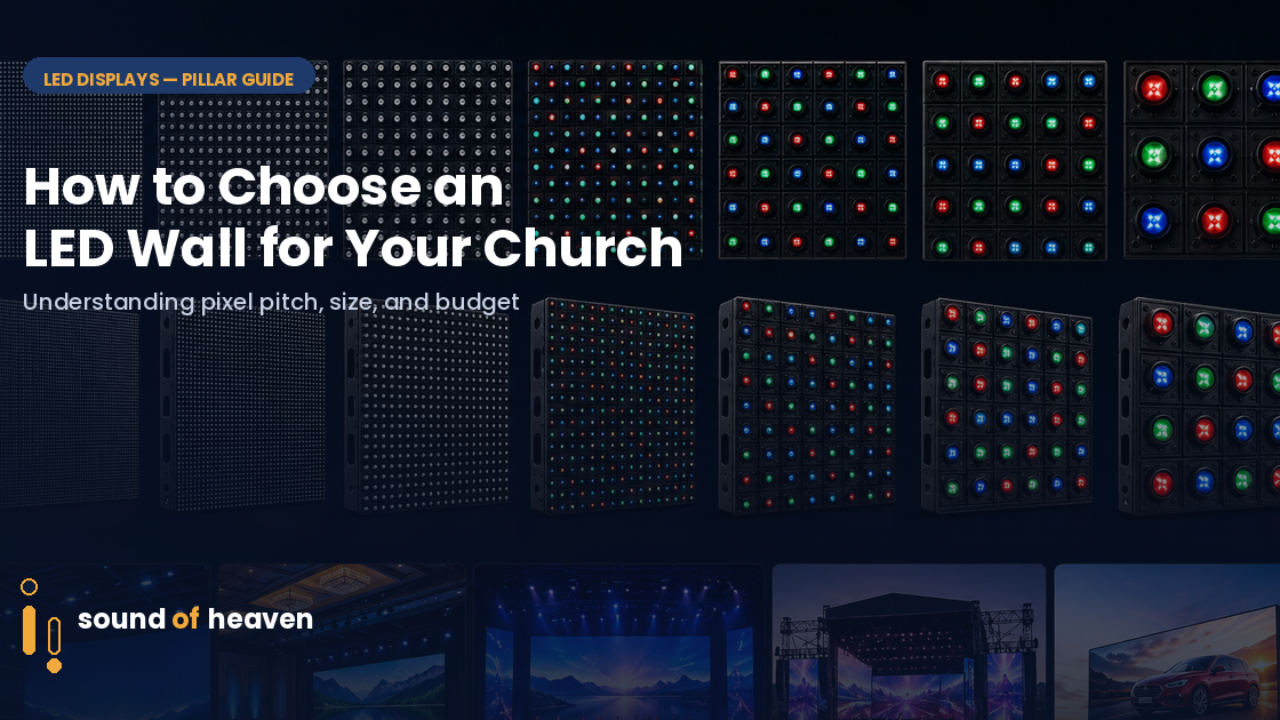
Pixel pitch affects your LED wall by controlling how sharp the image looks at any given distance. It's the space between individual LEDs on the panel, measured in millimeters. A smaller number means the pixels sit closer together, producing a sharper image at close range.
AVIXA, the trade association for the AV industry, explains that a simple shortcut called the 10x Rule estimates viewing distance by multiplying the pixel pitch by 10.
So a 2.5 mm pixel-pitch wall looks sharp starting at around 25 feet away. Christie Digital, a major display manufacturer, adds that pixel pitch and viewing distance are directly linked: the closer your congregation sits, the smaller the pitch needs to be for a clean image.
For most sanctuaries, where the front row sits 15 to 20 feet back and the rear seats fall somewhere between 60 and 100 feet out, a pixel pitch in the P2.5 to P3.9 range hits the sweet spot between sharpness and cost.
Going finer than that often means paying for resolution nobody in the room will actually notice.
Pixel pitch decides clarity. Screen size decides impact.
What Size LED Wall Does Your Sanctuary Need?
Your sanctuary's LED wall size comes down to three measurements: stage width, ceiling height, and how far your back row sits from the platform.
The exact math gets more specific than this, and it's worth getting right before you buy. So we built a full walkthrough with a simple formula you can use with just a tape measure in What Size LED Wall Does My Church Need?
Where the wall lives changes more than its size, though. It also changes what kind of panel you need entirely.
Indoor vs. Outdoor LED Walls: What's the Difference?
The difference between indoor and outdoor LED walls is weatherproofing and brightness. Indoor panels aren't built to handle weather, are designed for closer viewing distances, and don't need the extra brightness required to compete with direct sunlight.
Outdoor panels are sealed against moisture and dust, and they run significantly brighter to stay visible in daylight. If your project is for the sanctuary stage, you'll be looking at indoor panels.
If you're considering a display for an outdoor gathering space or entrance, that's a different product entirely, with different pricing.
Once you know your pixel pitch, size, and panel type, the last two pieces are budget and how you'll pay for it.
How Much Should You Budget for a Church LED Wall?
Your budget for a church LED wall depends heavily on the combination of size and pixel pitch you land on, which is exactly why a general number isn't very useful on its own. A small, wide-pitch wall and a large, fine-pitch wall can be worlds apart in price even if they look similar in a sales brochure.
Rather than guess here, we put together a full pricing breakdown, including the hidden costs most charts skip, in How Much Does a Church LED Wall Cost?. It's worth reading before you request quotes, so you know whether a number you're given is reasonable for what you're actually buying.
Budget concerns are usually the biggest hesitation point for churches considering an LED wall, which is exactly why financing matters so much here.
What Financing Options Are Available for Church LED Walls in the U.S.?
Sound of Heaven offers 0% interest and in-house financing specifically for LED wall installations, with no bank involved and no credit check required.
- 0% interest: no added cost for financing instead of paying upfront.
- No bank, no credit check: managed directly through Sound of Heaven, not a third-party lender.
- 12-month plan: the balance is paid off within a year.
- 50% down: the remaining balance is split across the 12-month term.
This is different from how audio, video, and lighting projects are financed. Which runs through Hampton Ridge Financial, a lender that specializes in equipment financing for houses of worship.
You can see the full breakdown of both paths on our Financing page. Also check out a more detailed walkthrough of the LED-specific option in How to Finance a Church LED Wall With 0% Interest and No Credit Check .
What Mistakes Do Churches Make When Choosing an LED Wall?
Churches make a few mistakes again and again when choosing an LED wall, and most of them are avoidable with the right guidance up front.
Buying a pixel pitch finer than needed
If your back row sits 80 feet out, a P1.5 wall is solving a problem you don't have at a price you didn't need to pay.
Underestimating brightness needs
A wall that looks great in a dim showroom can wash out completely under stage lighting if brightness wasn't planned for the room.
Not planning power and cabling early
LED walls need dedicated power runs and structural support. Bringing this up after the wall arrives, instead of during the design phase, is one of the most common causes of installation delays.
Treating the LED wall as a standalone purchase
A wall installed without considering how it interacts with your existing lighting and camera systems often creates more problems than it solves.
This is the same reasoning behind planning your whole system together, which we cover in What Is Church AVL Integration? All You Need to Know.
Getting any of these wrong tends to be expensive to fix after the fact, which is exactly why a proper walkthrough before you buy is worth the time.
Summing It Up…
Choosing an LED wall for your church isn't a huge technical hurdle once you break it into its real parts: pixel pitch, size, indoor vs. outdoor build, budget, and financing.
Most churches that end up overpaying or unhappy with their wall- skipped one of these steps, not because the decision was too hard. But nobody walked them through it clearly first.
If your church started reading this because you already know an LED wall is on your list, What Are LED Walls for Churches? All You Need to Know is a good next read on why churches are making the switch from projectors in the first place.
Ready to walk through pixel pitch, sizing, and financing for your specific space? Book a free consultation and we'll help you figure out exactly what fits your sanctuary and your budget.
Read Also:
- What Are LED Walls for Churches? All You Need to Know
- What Is Church AVL Integration? All You Need to Know
- Explore our LED Displays services
Frequently Asked Questions
What is the difference between pixel pitch and resolution?
Pixel pitch is the physical distance between LEDs on the panel, measured in millimeters. Resolution is the total number of pixels the wall can display. A smaller pixel pitch generally means higher resolution for the same physical size, since more pixels fit into the same space.
Can a small church afford an LED wall?
Yes, especially with financing that doesn't require a large upfront cost. A smaller wall with a wider pixel pitch, sized appropriately for a smaller sanctuary, costs significantly less than the large fine-pitch walls seen in bigger productions. Size and pitch should always match your actual room, not a bigger church's setup.
Is an LED wall better than a projector for a church?
For most churches, yes, mainly because LED walls stay bright and clear even with stage lighting on, while projected images can wash out. We cover this comparison in full in What Are LED Walls for Churches? All You Need to Know.
How long does it take to install a church LED wall?
Installation timelines vary based on wall size and whether structural or electrical work is needed first, but once equipment arrives, physical installation for a standard sanctuary wall typically takes a few days. Planning and design work ahead of the installation date is what most affects the overall timeline.
Do I need to replace my existing screen or projector, or can an LED wall work alongside it?
Many churches remove the projector once the LED wall goes in, since the wall handles the same content, lyrics, scripture, and video, with better visibility. Some churches keep a projector for secondary spaces, like a lobby or overflow room, while the LED wall becomes the main sanctuary display.
Don't miss a beat!
New moves, motivation, and classes delivered to your inbox.
We hate SPAM. We will never sell your information, for any reason.