
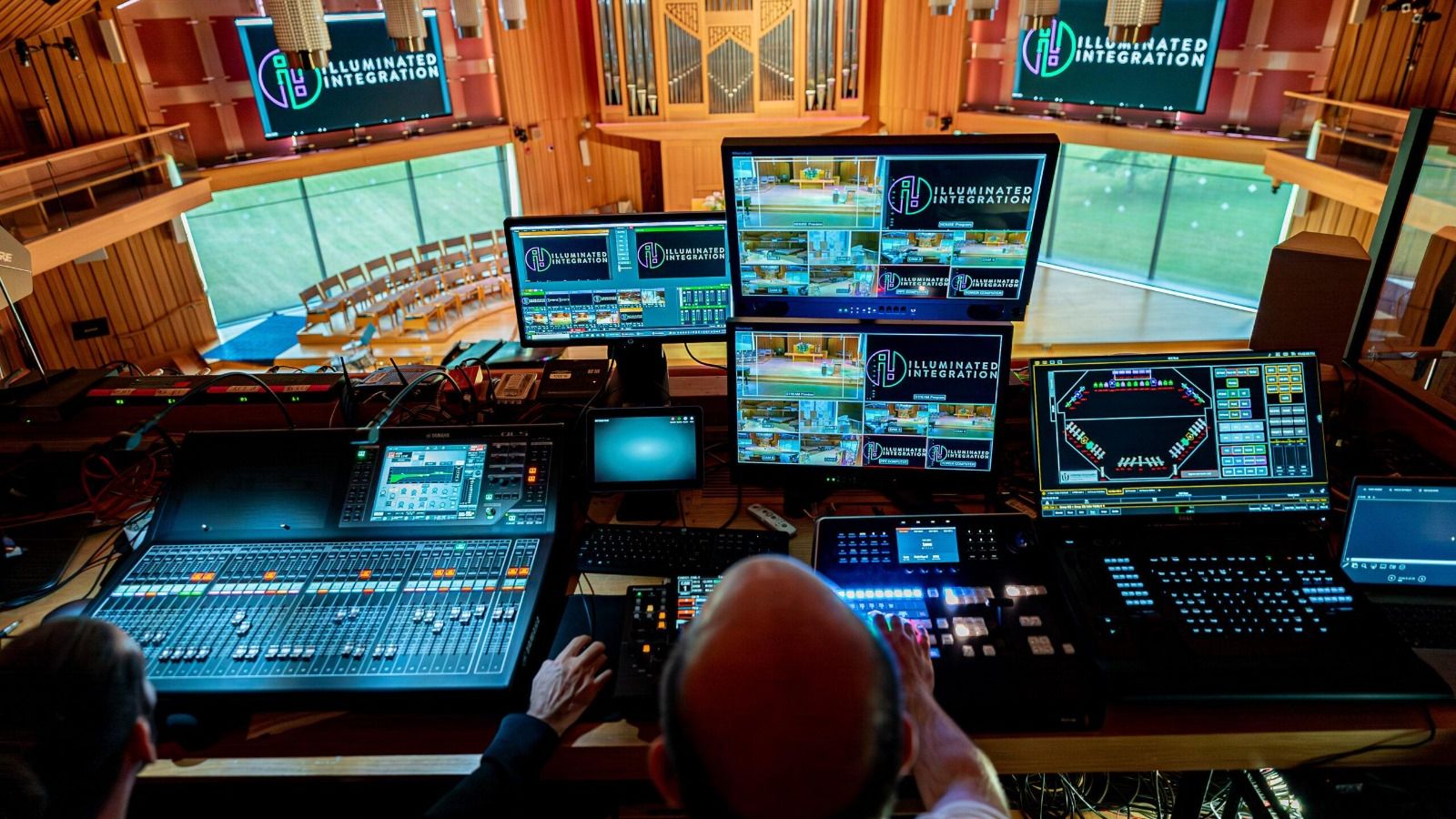
What Is Church AVL Integration? All You Need to Know
Apr 18, 2026Think about the last time something went wrong during a service.
Maybe the sound was clear on one side of the room and almost inaudible on the other. Maybe the stage looked fine to the congregation but came out dark and flat on the livestream. Maybe the screen was running a beat behind the worship team, and the congregation was reading lyrics that had already passed. Maybe the pastor walked to the pulpit and the audio took a few seconds to catch up.
Nobody bought bad equipment. Nobody on the team was being careless. Everything in that room was purchased with good intentions, at different times, by different people, trying to solve different problems.
But nothing was ever planned to work together.
That is the AVL problem. And it is the reason so many churches keep dealing with the same technical issues week after week, no matter how much equipment they buy or how many volunteers they train.
This article explains what church AVL integration is, what it includes, why it matters, and what it looks like when it is done right.
What Does AVL Stand For?
Before anything else, let us make sure the term is clear.
AVL stands for Audio, Visual, and Lighting. These are the three technical systems that work together to support everything that happens during a church service.
Audio: Is everything related to sound. Microphones, speakers, mixing consoles, stage monitors, and the signal that feeds the livestream.
Visual: Is everything the congregation sees on a screen. Lyrics, scriptures, sermon notes, announcement slides, and the video feed from cameras.
Lighting: Is everything that controls how the stage, the room, and the cameras experience light. This includes stage lighting, house lighting, and the lighting that makes video look clean and professional.
Each one of these systems matters on its own. But the most important thing is not whether your church has all three. Rather whether all three were planned to work together. That is what integration means.
What Is Church AVL Integration?
Church AVL integration is the process of planning, designing, and installing your audio, visual, and lighting systems as one connected setup, not three separate systems that happen to exist in the same room.
Most churches have all three systems. Very few churches have them integrated.
In a church without AVL integration, the sound engineer is running one system, the screen operator is running another, and the lighting person is running a third. None of these systems talk to each other. When the worship leader transitions into a spontaneous moment, the lighting does not respond.
When the pastor moves from the sermon into an altar call, the audio transition requires manual adjustment from someone who may not have been told it was coming. When the service goes to livestream, the audio feeding the camera is pulled from the same mix as the room, which means the online audience hears everything: the room reverb, the congregation noise, all of it.
Now picture a church with proper AVL integration. The worship leader moves into that spontaneous moment, and the lighting shifts to match because it was designed to respond. The pastor transitions to the altar call, and the audio is already set up to handle that moment cleanly.
Everything communicates with everything else. That is integration.
What Does a Church AVL System Actually Include?
A complete church AVL integration setup covers four areas. Let us go through each one.
- Audio:
This is the full signal chain from the source to the listener. It includes microphones for the pastor, worship leader, and musicians. It includes the main speakers that cover the congregation.
It includes stage monitors or in-ear monitors that let the worship team hear themselves clearly. It includes the mixing console where a sound engineer balances all of those signals. And it includes the separate audio routing that feeds a clean signal to the livestream, completely independent from the room mix.
When church audio systems are planned correctly, the congregation hears clearly from every seat. The worship team performs with confidence because their monitors are reliable. And the online audience hears a clean, consistent mix every single week.
- Visual:
This covers everything the congregation sees on a screen during the service. It includes the display itself, whether that is a projector, an LED screen, or a full LED wall for churches. It includes the media computer and software that runs the slides. It includes confidence monitors on stage so the worship leader can see the lyrics without turning around. And it includes the video routing that sends the right image to the right screen at the right time.
Many churches are now moving from projectors to LED displays because they are brighter, more reliable, and easier to see from any seat in the room. This is one of the areas where the right choice at the planning stage saves a church from upgrading twice within a few years.
- Lighting:
Church lighting has three separate jobs, and each one matters.
Stage lighting supports the worship moment. It helps the congregation focus on what is happening at the front of the room. It creates an environment that serves the tone of the service, whether that is an intimate prayer moment or a full congregational worship set.
House lighting manages the congregation's experience. Too bright and the screens wash out. Too dark and people cannot read their Bibles or find their seats.
Camera lighting is what makes the livestream look like a real broadcast and not a dim recording. This is the one most churches miss. What looks fine to the human eye in a room does not always translate well to a camera. Worship lighting that is planned with cameras in mind changes the quality of everything recorded and streamed.
- Cameras and Video:
This is the system that captures the service for livestream, recording, and overflow spaces. It includes the cameras themselves, the video switcher that cuts between angles, and the signal routing that sends clean video to the streaming platform. When church camera systems are part of the AVL plan from the beginning, the livestream looks intentional, not like an afterthought.
Why Most Churches Are Struggling With AVL Integration
Most churches that have AVL problems do not know that AVL integration is the root of it. They just know that something always feels off.
These are the signs to look for:
The sound changes from Sunday to Sunday, and nobody can explain why. One week it is clear. The next week it is muddy. The team did not change. The songs did not change. But the result is different every time.
The lighting looks fine in the room, but the livestream looks dark and flat. The cameras are capturing a completely different picture from what the congregation is seeing.
The livestream audio sounds like a recording of a room, not a clean broadcast. Online viewers are hearing reverb, congregation noise, and inconsistent levels.
Volunteers feel stressed every single week because the systems are complicated and unpredictable. They are not serving with confidence. They are surviving the service.
Screens lag behind the worship team. Lyrics appear after the congregation has already moved to the next line.
None of these are equipment failures on their own. They are integration failures. And they will keep happening, no matter how much new equipment a church buys, until the system is planned as one.
What Happens When AVL Integration Is Done Right
Now let us flip the picture.
When church AVL integration is done correctly, Sunday morning changes entirely. The service flows without interruptions. The congregation, from the front row to the back corner, hears clearly. The worship team performs with confidence because their monitors are reliable and consistent. The lighting supports every moment of the service without anyone having to make frantic adjustments. The screens are sharp, bright, and perfectly in sync with what is happening on stage.
The livestream sounds and looks like a professional broadcast. Online members experience the service clearly, not as a lesser version of what is happening in the room.
And the volunteers running all of it are calm. They are not troubleshooting in the middle of the service. They are serving. Because the system was built to be simple enough for a volunteer team to run consistently, week after week.
The pastor and the worship leader are completely focused on the ministry moment. Not glancing at the sound booth. Not signaling to the screen operator. Not adjusting for technical problems. Just leading.
That is what AVL integration makes possible.
How Sound of Heaven Approaches Church AVL Integration
This is where it is important to understand that not every approach to church AVL integration is the same.
Some companies show up with a product catalog. They recommend equipment based on what is popular or what fits a budget. The church buys it, someone installs it, and then the team figures out how to use it. That is not integration. That is shopping.
Sound of Heaven starts somewhere different. Before any equipment is discussed, the conversation begins with the church. The room layout. The stage design. The acoustics. The size of the volunteer team. The budget. The goals. The way the church runs its services. The moments that matter most on a Sunday morning.
From that conversation, a complete AVL integration plan is built. Audio, visuals, lighting, and cameras are all designed to work together from day one. Not added one piece at a time. Not patched together as problems come up. Planned as one system, built for that specific church, and installed for the volunteer team that will run it every week.
This approach also connects directly to Altura LED Displays for churches that are ready to move from projectors to professional-grade LED screens. And it connects to worship team development for churches that want to train the people running the system, not just install the system itself.
Because a great AVL system with an untrained team will still produce inconsistent results. And a trained team running a poorly integrated system will still struggle every Sunday. Both matter. That is why Sound of Heaven addresses both.
When Is the Right Time to Think About AVL Integration?
This is a question many pastors ask. And the honest answer is earlier than most churches think.
AVL integration is the right conversation for your church if:
You are moving into a new building and want to get the infrastructure right from the beginning. This is the best time. Planning AVL before walls are finished saves significant time and money compared to retrofitting later.
You are renovating your existing space. A renovation is the right moment to look at the whole system, not just replace one piece of equipment.
You are upgrading from projectors to LED displays and want the visual system to connect properly with your audio and lighting.
Your current system was built piece by piece over several years, and Sunday mornings feel like a weekly struggle.
You have started livestreaming, and the production quality does not reflect the quality of your ministry.
You do not need a massive budget or a large building to think about AVL integration. You need a plan. And the right time to make that plan is before the next purchase, not after.
Summing it up…
Church AVL integration is not a technical luxury for large churches with big budgets. It is the foundation that makes every other part of church production work properly.
When audio, visuals, lighting, and cameras are planned together as one system, services run with less stress, volunteers serve with more confidence, and the congregation, both in the room and online, can stay focused on what matters most.
The problems most churches deal with every Sunday are not people problems. They are system problems. And system problems are fixed with proper planning, not more equipment.
If your church is ready to stop patching things together and start building a worship production system that actually works, the next step is a conversation.
Book a free consultation with Sound of Heaven. Talk through your space, your team, your goals, and what a complete church AVL integration plan looks like for your ministry.
Don't miss a beat!
New moves, motivation, and classes delivered to your inbox.
We hate SPAM. We will never sell your information, for any reason.