
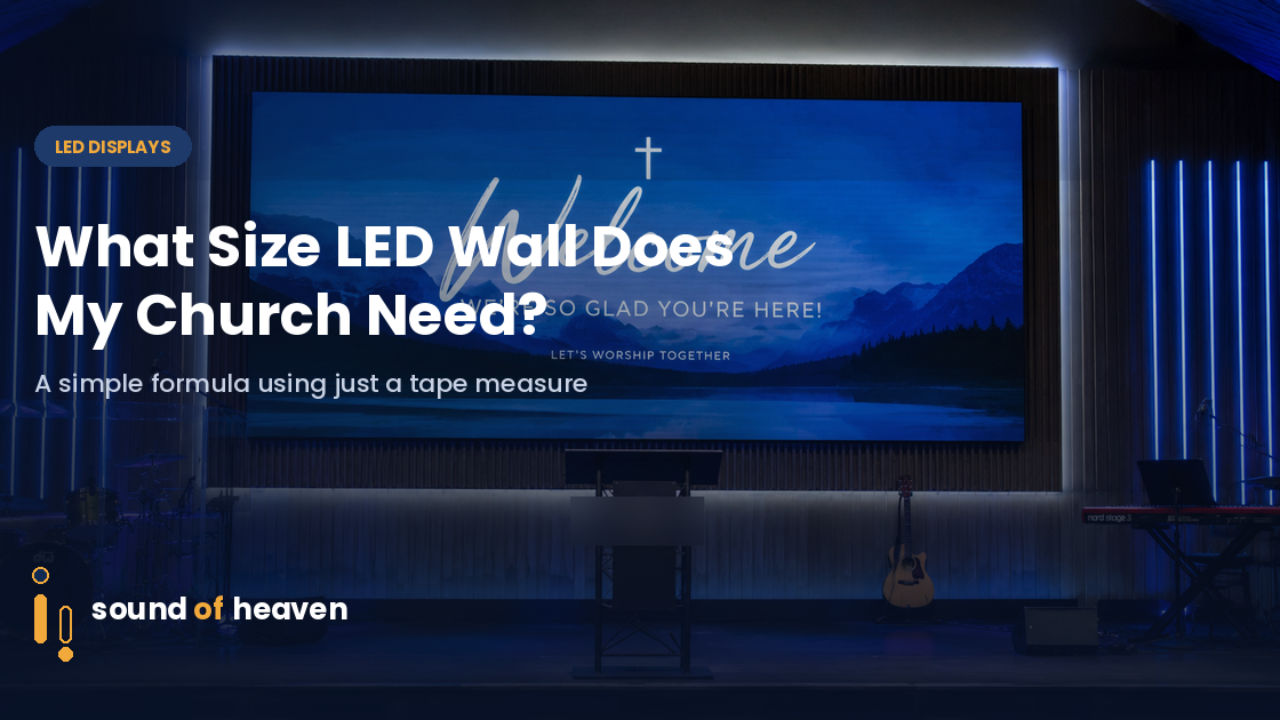
What Size LED Wall Does My Church Need? A Complete Guide for Pastors
Aug 05, 2026What size LED wall a church needs comes down to three measurements you can take yourself with a tape measure: stage width, ceiling height, and the distance from your platform to the back row.
This guide walks through each one, plus a simple way to check your pixel pitch against your actual room before you buy.
What Measurements Do You Need Before Sizing an LED Wall?
You need three measurements before sizing an LED wall: your stage width, your ceiling height, and the distance from your platform to your farthest seat.
- Stage width: measure the usable width of your platform, wall to wall, minus any space needed for aisles, stairs, or side equipment.
- Ceiling height: measure from the stage floor to the lowest point your rigging or structure allows, since this caps how tall your wall can go.
- Back row distance: measure from the front of the stage to your farthest occupied seat, since this determines how fine your pixel pitch needs to be.
Take all three before requesting a quote. A company that can size your wall accurately without ever asking for these numbers is guessing, not measuring.
How Wide Should Your LED Wall Be?
Your LED wall should cover roughly 60 to 80 percent of your stage's usable width. This range is a common starting point across church installations. Because it fills the visual space behind your worship team without crowding out room for lighting fixtures, side screens, or sightlines from angled seating.
A stage with 30 feet of usable width, for example, would typically support a wall between 18 and 24 feet wide.
Going wider than that risks the wall overwhelming your platform. Going narrower can make the wall look like an afterthought instead of the visual anchor of the room.
How Tall Should Your LED Wall Be?
Your LED wall's height should follow your screen's aspect ratio once width is set, most commonly 16:9. Which is the standard format for nearly all video, lyric, and broadcast content.
Chipshow, an LED panel manufacturer, explains that if your wall's physical ratio doesn't match your content's format, you end up with stretched images, cropped content, or black bars along the edges.
For a wall built in 16:9, height comes out to roughly 56 percent of the width. An 18-foot-wide wall, for instance, lands around 10 feet tall.
Your ceiling height measurement from earlier determines whether that height actually fits your room, along with any rigging, speakers, or lighting trusses already occupying that space.
How Does Back-Row Distance Affect Pixel Pitch?
Your back-row distance determines the widest pixel pitch you can use without visible pixelation. AVIXA, the AV industry's trade association, uses a simple shortcut called the 10x Rule: multiply the pixel pitch in millimeters by 10 to estimate the minimum comfortable viewing distance in feet.
- P2.5 pixel pitch: comfortable viewing starts around 25 feet.
- P3.9 pixel pitch: comfortable viewing starts around 39 feet.
- P4.8 pixel pitch: comfortable viewing starts around 48 feet.
If your front row sits closer than the pitch allows, viewers there may notice individual pixels rather than a smooth image.
Match your pitch to your closest seat, not your farthest one, since the front row is where pixelation shows up first.
What's a Simple Way to Check Your Numbers Before Buying?
A simple way to check your numbers is to compare your front-row distance against the AVIXA 10x Rule for each pixel pitch under consideration.
- Measure your front-row distance to the stage.
- Divide that distance by 10 to find the maximum pixel pitch (in millimeters) that stays sharp from that seat.
- Compare that number to your stage width and ceiling height to confirm a wall of the right size will actually fit your room.
- Check the result against your budget, since finer pixel pitch costs more, covered in full in How Much Does a Church LED Wall Cost?
This won't replace a professional site assessment, but it gives you a real starting point instead of guessing or relying on what a bigger church down the road installed.
Summing It Up…
Sizing an LED wall for your church starts with three measurements you can take today: stage width, ceiling height, and back row distance.
Width typically covers 60 to 80 percent of your stage, height follows your aspect ratio, and pixel pitch should match your closest seat using the AVIXA 10x Rule.
Getting these numbers before you request quotes means you'll know whether a proposal actually fits your room, instead of taking a vendor's word for it.
For the full decision process, including budget and financing, see our complete guide on How to Choose an LED Wall for Your Church.
Want an exact size recommendation for your sanctuary? Book a free consultation and we'll measure your space and confirm the right size and pixel pitch for your room.
Read Also:
- How Much Does a Church LED Wall Cost?
- Explore our LED Displays services
Don't miss a beat!
New moves, motivation, and classes delivered to your inbox.
We hate SPAM. We will never sell your information, for any reason.