
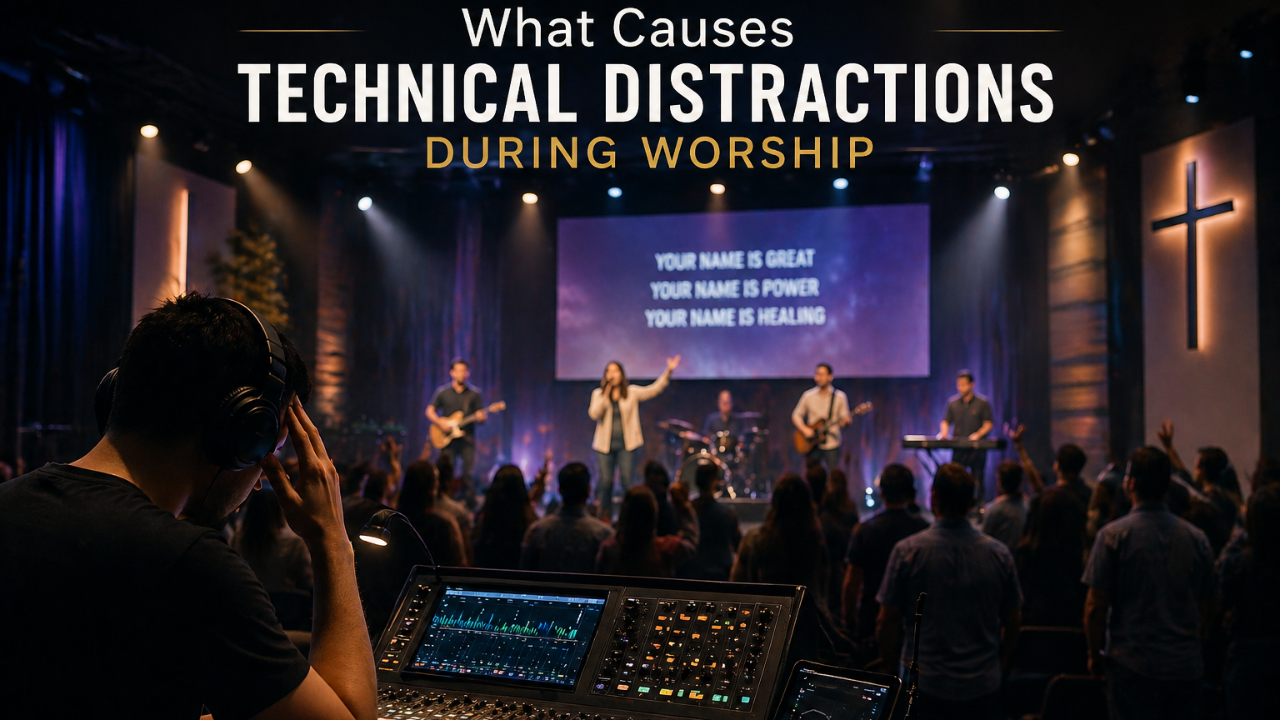
What Causes Technical Distractions During Worship (And How to Fix Them)
Apr 27, 2026During a worship set, the atmosphere can be so spirit-filled until a microphone drops out. Or the lyrics freeze on the screen. Or a sharp burst of feedback cuts through the room and breaks everyone’s focus.
Just like that, eyes open. Hands drop. People are no longer engaged in worship. Instead, they are looking around, trying to figure out what happened. The worship leader continues, but the atmosphere has changed.
This happens in churches of every size, every week. These moments are known as technical distractions during a worship service. In this article, we’ll break down what causes technical distractions during a worship service and what your church can do to fix them so your services are never interrupted.
What Counts as a Technical Distraction During Worship
A technical distraction is anything that pulls the congregation's attention away from worship because of a production failure. It is not the same as a spiritual distraction. It is a system breakdown that interrupts the flow of the service.
It could be a microphone that cuts in and out. A screen that goes blank right before the second verse. A livestream that drops at the worst time. Or lighting so dim that the congregation can barely see the stage.
These things may seem small in isolation. But in a worship environment, where atmosphere and focus matter deeply, even one technical failure can shift the entire mood of a service. And when it happens every week, people begin to expect it, and that is a bigger problem.
The Most Common Causes of Technical Distractions
These are the most common causes of technical distractions in any size church:
-
Poor audio setup and unmanaged feedback
Audio is the first thing people notice when something goes wrong. That sharp, piercing feedback sound. A vocalist whose microphone is too low. A pastor whose voice echoes strangely in the room. These issues almost always come from a church audio system that was not set up correctly for the space or from gain levels and monitor mixes that nobody has properly managed.
Microphones placed too close to speakers, monitors pointed in the wrong direction, or a mixing console nobody fully understands—any of these can cause audio problems that disrupt worship every single week.
-
Screens and visuals that fail or lag
When lyrics are late, wrong, or missing entirely, the congregation is left guessing. Some people stop singing. Others look around. A few get frustrated. This usually happens when the software is not updated. Or the operator is not familiar with the flow of the service, or the display hardware is old and struggling to keep up.
Church visual systems — whether projectors or LED walls for churches — need to be reliable and operated by someone who knows the service order well enough to stay ahead of the worship team, not behind them.
-
Weak or unplanned lighting
Lighting is one of the most overlooked parts of worship production. Many churches either have lights that are too bright and clinical or too dim for people to see anything clearly. Neither works well.
When the stage is poorly lit, cameras cannot capture a clear image for the livestream. When the congregation area is too dark, people feel disconnected. Good worship lighting is not about drama. It is about visibility, clarity, and helping people stay focused on what is happening on the stage.
-
Livestream issues that break the online experience
Many churches added livestreaming quickly, without planning it into the rest of the production system. The result is an online experience that sounds different from the room, has poor camera angles, or drops entirely mid-service.
For online members, a bad livestream is the same as a bad seat. If they cannot hear clearly or follow the lyrics, they disengage. A proper worship livestream setup routes audio intentionally, positions cameras thoughtfully, and makes the online experience feel like a real part of the service, not an afterthought.
-
Volunteers running systems they were never trained on
This is one of the biggest causes of technical distractions that churches rarely talk about. A volunteer who was handed a role without proper training will do their best. But their best, without guidance, often leads to inconsistency. Different settings every week. Mistakes under pressure. Burnout over time.
It is not the volunteer's fault. It is a system and training gap. When nobody has built a clear, repeatable workflow, every Sunday becomes a new experiment.
How to Fix Technical Distractions Before They Happen
-
Do a full system check before every service
Before the congregation walks in, everything should be tested. Microphones. Screens. Lights. Cameras. Livestream feed. A simple pre-service checklist, done consistently, catches most problems before they become distractions. This does not require extra budget. It requires a habit.
-
Build simple, repeatable workflows for volunteers
Every volunteer on your production team should have a clear role, a written process, and enough practice to feel confident. When the workflow is simple and consistent, volunteers stop guessing and start serving with steadiness. Confidence behind the sound board changes everything.
-
Plan your worship production system as one unit
Most technical distractions come from systems that were never designed to work together. Audio, visuals, lighting, and cameras need to be planned as one worship production system, not separate purchases made at different times. When everything is integrated, the whole service runs more dependably.
-
Invest in training, not just equipment
New gear does not fix an untrained team. Before your church upgrades any equipment, make sure the people running it understand what they are doing and why. Training your volunteers is one of the highest-return investments a church can make in its production.
In Summary…
Technical distractions during worship can be fixed. In most cases, they are not random issues. They happen because something in the system is not properly set up, tested, or clearly handled.
It could be audio that was not checked during the soundcheck. Or lyrics that were not prepared in order and lighting that is not set for the service flow. Or a livestream setup that was not tested before people joined. Small gaps like these are what lead to distractions during the service.
When your audio, visuals, lighting, and livestream systems are planned to work together, and your team knows exactly what to do, things change. Sound stays clear. Lyrics stay in sync. Transitions happen smoothly. The service flows without interruptions, and the congregation stays focused on worship.
If your church is dealing with repeated technical issues, it is time to look at both your setup and your team. At Sound of Heaven, we help churches build reliable worship production systems, improve team structure, and remove the technical problems that keep showing up every Sunday.
Book a free consultation, and we will walk through your current setup, identify what is causing the issues, and help you take the next step with clarity.
Don't miss a beat!
New moves, motivation, and classes delivered to your inbox.
We hate SPAM. We will never sell your information, for any reason.