
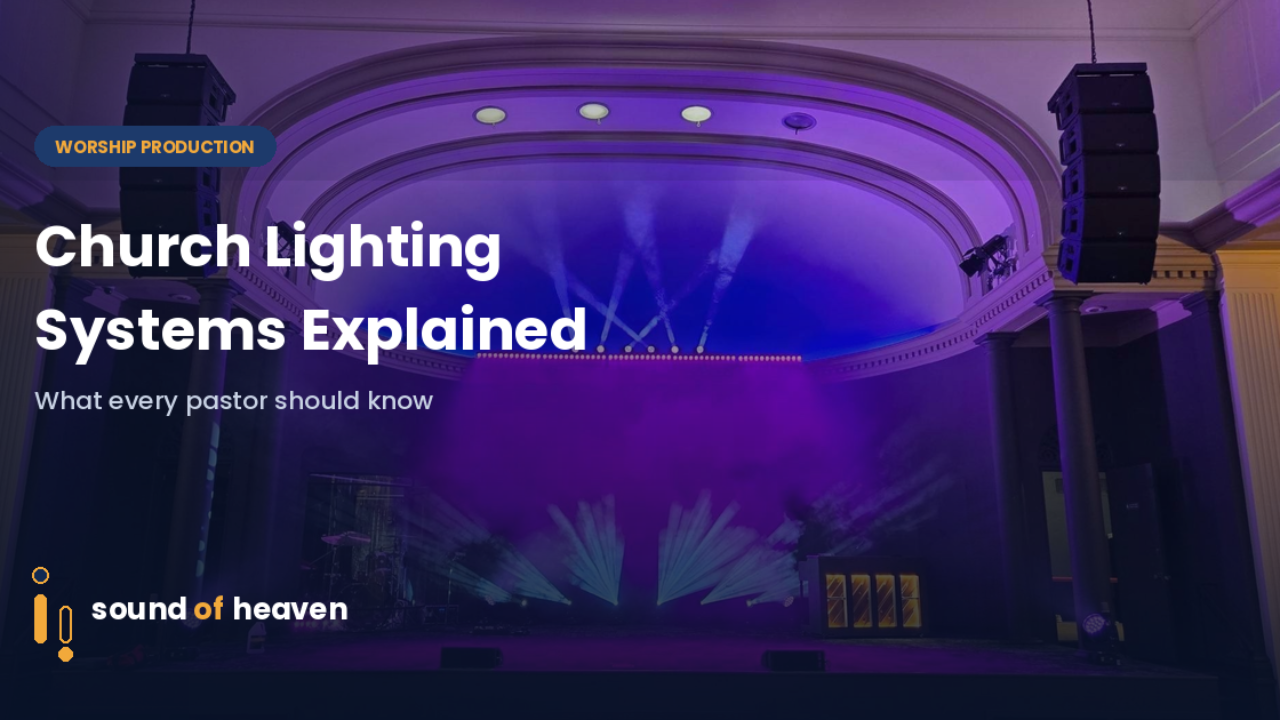
Church Lighting Systems Explained: What Every Pastor Should Know
Jul 27, 2026Church lighting systems shape how every single Sunday feels, whether anyone in the room realizes it or not. Sunday morning starts the same way at a lot of churches.
The band walks out. The lights come up. And somewhere in the back, a volunteer is squinting at a lighting board, hoping the right buttons get pressed at the right time.
If you're a pastor, you probably don't need to know how to run that board yourself. But you do need to understand what your church lighting system actually does, because it shapes how every single service feels.
A well-designed church lighting setup helps people see the message. Bad lighting distracts from it.
This guide breaks down church lighting in plain terms. No jargon. Just what you need to know to make smart decisions for your church.
What Does a Church Lighting System Actually Do?
A church lighting system does three jobs at once: it helps people see, it sets the mood, and it supports your camera if you livestream.
Think about it this way. If your speaker's face is in shadow, people in the back row struggle to connect with the message.
If the lighting never changes, worship can feel flat, no matter how good the band is. And if your lights aren't built for cameras, your online congregation sees a dim, washed-out picture every week.
Sweetwater's InSync guide on church lighting points out that lighting serves three major
functions in a church setting: visibility, atmosphere, and camera support.
What Are the Main Types of Church Lighting Fixtures?
Most churches use a mix of fixture types, and each one has a specific role.
-
Wash lights
These spread soft, even light across a wide area, like the stage or a choir. They're the foundation of most church lighting setups.
-
Spotlights
These focus a tight beam on one specific spot, like a speaker at the pulpit. Gear4music's church stage lighting guide explains that spotlighting helps draw attention to a speaker, musician, or key moment in the service. While wash lighting covers wider areas with consistent color.
-
Moving heads
These fixtures pan, tilt, and change color on command. They're more flexible than fixed lights, which is why larger churches use them for dynamic worship moments.
-
Uplights and background lights
These add color and depth behind the stage. They're often what gives a church stage that layered, professional look.
-
House lights
These light the area where your congregation sits, not the stage. Titan AVL's guide to church lighting notes that house lighting should make it easy for people to read, take notes, and follow along without feeling harsh or overly bright.
If you want the full breakdown of how stage lighting and house lighting are actually different jobs, we cover that in detail in The Difference Between Stage Lighting and House Lighting in a Church.
What Is DMX and Why Does It Matter?
DMX is the standard control language that lets one operator run every light in the building from a single board.
Here's why that matters. Without DMX, every fixture needs its own separate dimmer or switch. That might work with two or three lights. It falls apart fast once your church has a dozen fixtures, moving heads, and color washes all running at once.
With a DMX-controlled system, your volunteer can build a lighting scene ahead of time, then recall it with one button during the service.
A DMX church lighting guide from VELLO reports that a correctly configured DMX setup transforms a stage from a static set of lights into a fully programmable system that one operator can run from a single position.
This is one of the biggest upgrades a church can make, and it's often more affordable than people expect.
How Bright Should Church Lighting Be?
Brighter isn't always better. In fact, over-bright lighting can wash out faces and cause real discomfort for your congregation.
SHEHDS' guide on stage lighting brightness found that most indoor stage performances need somewhere between 500 and 1,000 lux for basic visibility and 1,000 to 2,000 lux if you're using cameras for a livestream. Church settings usually lean toward the softer end of that range, since audiences sit close to the stage and comfort matters more than raw intensity.
The goal is to ensure your congregation notices the message, not the lights.
What Should Every Pastor Understand About Their Lighting System?
You don't need to become a lighting technician. But a few basics will help you make better decisions and ask better questions.
-
Warm light feels different from cool light
Warmer tones (around 2,700K to 3,000K) tend to feel cozy and inviting. Cooler tones (4,000K and up) feel more alert and energetic. Your lighting choice should match the tone of your service.
-
LED fixtures save money over time
Sweetwater reports that a modern LED lighting system can save as much as 85 percent in electricity costs compared to older traditional fixtures, while also running cooler and lasting longer.
-
Lighting should scale with your space
Church Stage Design Ideas' beginner lighting guide suggests that a small sanctuary under 1,000 square feet might only need four to six wash lights, while a large sanctuary needs beam spots and backlights for added depth.
-
Your camera sees light differently than your eyes do
If your church livestreams your services, your lighting needs to be strong enough for the camera, not just the room. Cameras don't have the same dynamic range as the human eye, so a room that looks fine in person can look dim and flat on screen. We cover more on this in 10 Church Livestream Tips for Better Audio, Video, and Viewer Engagement.
Why Lighting Deserves the Same Attention as Sound
Churches often spend years upgrading their sound systems before they ever think about lighting. That's understandable, since bad audio ends a service faster than anything else.
But lighting carries just as much weight in how people experience worship. It shapes first impressions for guests, supports your production team, and directly affects your livestream quality.
If your church has invested in a great sound system but still runs on outdated house lighting, you're only solving half the problem.
And if budget is the concern holding your church back, our post on How Small Churches Can Improve Worship Production Without a Big Budget is a good place to start.
This is exactly the kind of gap we help churches close. A full AVL system, meaning audio, video, and lighting working together, creates a service that feels connected instead of disjointed. You can read more about how that all fits together in What Is Church AVL Integration? All You Need to Know.
Frequently Asked Questions
-
How much does a church lighting system cost?
Costs vary a lot depending on your sanctuary size and the number of fixtures you need. A small church might spend a few thousand dollars on a basic wash and spot setup, while a larger sanctuary with moving heads, DMX control, and house lighting upgrades can run into the tens of thousands. The best way to get an accurate number is a walkthrough of your specific space.
-
Can volunteers run a church lighting system without special training?
Yes, if the system is designed with volunteers in mind. A well-programmed DMX system lets a volunteer recall pre-built lighting scenes with one button, instead of manually adjusting individual fixtures during a live service. The key is designing the system around your team, not around what a professional touring rig looks like.
-
What's the difference between LED and traditional stage lighting for churches?
LED fixtures use less electricity, run cooler, and last longer than older halogen or incandescent lights. According to Sweetwater, LED systems can cut electricity costs by as much as 85 percent compared to traditional fixtures, which adds up quickly for a church running lights every week.
-
How often should church lighting equipment be replaced?
There's no fixed timeline, but most LED fixtures last many years longer than traditional bulbs before needing replacement. The bigger question is usually whether your system still fits your church's needs, not just whether the fixtures still work. A church that's grown, added livestreaming, or expanded its stage often needs an updated system well before the old one fails.
Summing It Up
Church lighting systems do more than just keep the room lit. They shape visibility, atmosphere, and camera quality, all at once. Understanding the basics, wash versus spot, house versus stage, DMX control, and proper brightness, gives you the confidence to make smart decisions for your church, even if you never touch the lighting board yourself.
If your church is working with outdated lighting, weak visibility, or a system your volunteers can't figure out, it might be time for a proper evaluation.
Ready to see what a modern lighting system could do for your church? Book a free consultation with our team, and we'll walk you through what fits your space, your budget, and your team.
Read Also:
Don't miss a beat!
New moves, motivation, and classes delivered to your inbox.
We hate SPAM. We will never sell your information, for any reason.