
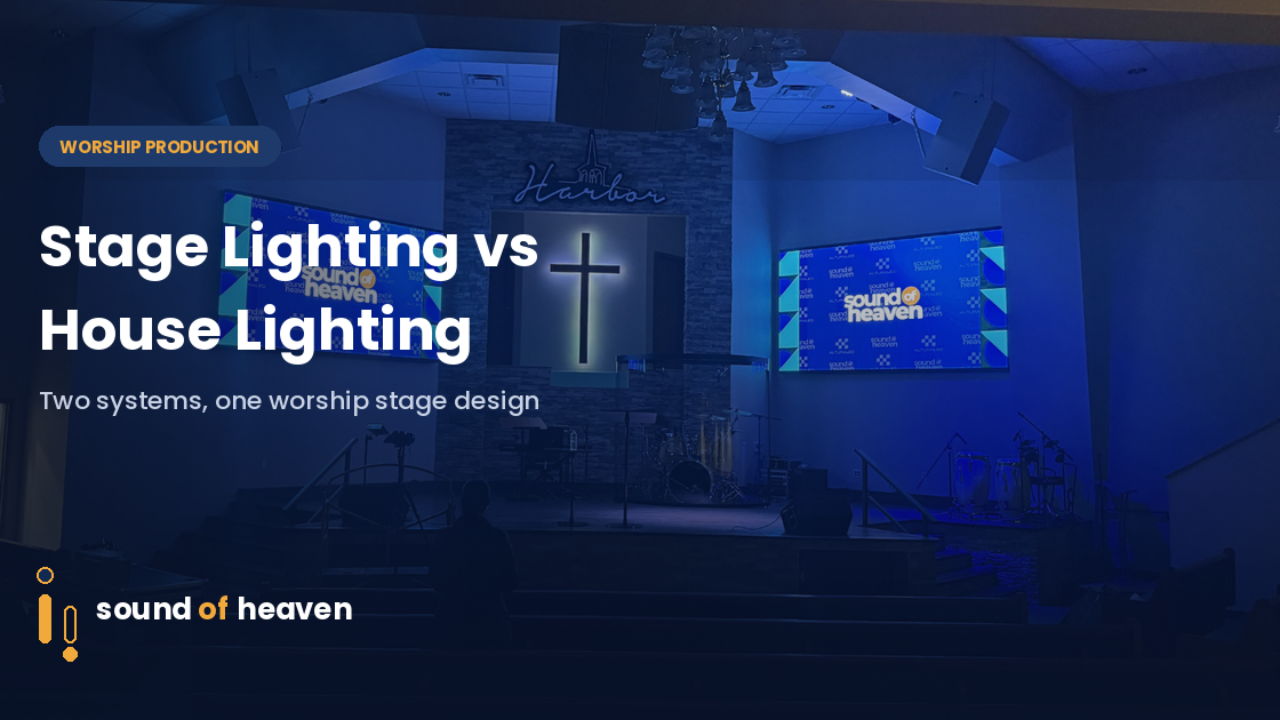
The Difference Between Stage Lighting and House Lighting in a Church
Jul 27, 2026Worship stage design depends on more than what happens on the platform itself, and most churches never realize it until something feels off.
Ask most church volunteers to explain the lighting system, and you'll usually get an answer about the stage. That makes sense, since the stage is where the action happens. But there's a second lighting system working the entire time, and it's just as important: house lighting.
Understanding the difference between these two systems is one of the most overlooked pieces of worship stage design. A properly planned church lighting system accounts for both.
Get it right, and your whole room feels connected. Get it wrong, and your congregation feels disconnected from what's happening up front, even if the stage itself looks great.
What Is Stage Lighting in a Church?
Stage lighting is the lighting system used to illuminate the people and elements on the platform, your speaker, your worship team, and your set design.
Titan AVL's guide to church lighting explains that stage lighting can be bright, change color, and shift direction, helping everyone see what's happening on stage.
This system is especially important for churches with bands, choirs, or larger gatherings, where the visual energy of the platform plays a bigger role in the service.
Stage lighting typically includes:
- Wash lights for even coverage across the platform
- Spotlights to highlight a speaker or soloist
- Moving heads for dynamic color and movement
- Backlights and uplights to add depth and separation from the backdrop
What Is House Lighting in a Church?
House lighting is the lighting system for the area where your congregation sits, not the stage.
Titan AVL notes that house lighting should make it easy for people to read, take notes, and follow along during the service. It needs to be bright enough for comfort without feeling harsh or clinical.
Springtree Media's guide on church house lighting points out that house lighting is usually run on a dimmer system, and the goal goes beyond just visibility.
Good house lighting brings the congregation into the worship experience as participants, not just spectators watching a stage from a distance.
Why Do These Two Systems Need to Work Together?
Stage lighting and house lighting aren't separate decisions. They need to be coordinated, because your congregation experiences both at the exact same time.
Here's a simple example. If your stage lighting dims dramatically for a reflective worship moment but your house lights stay at full daytime brightness, the room feels disconnected.
The stage is trying to create intimacy, while the house lighting is undercutting it. This kind of mismatch is one of the small production gaps we unpack in Worship Production vs Worship Leading: What's the Difference?
Presence Pro Audio's church lighting guide points out that you can bring your stage's color palette out into the congregation area during worship moments, creating a more immersive, unified experience across the entire room.
That coordination is what separates a professionally designed worship space from one where the stage and the seating area feel like two different rooms.
What Mistakes Do Churches Commonly Make With These Systems?
Most churches don't get this wrong on purpose. It usually comes down to budget sequencing, upgrading the stage first and forgetting the house lights entirely.
Common mistakes include:
- Treating house lighting as an afterthought: Many churches invest heavily in stage lighting but leave old fluorescent or fixed-brightness fixtures over the congregation.
- Using cold white light throughout the sanctuary: Springtree Media found that LEDs can create a very cold-looking white light if you're not careful, and warm white tones create a much more welcoming, comfortable feeling for a place of fellowship.
- Running house lights at one static setting all service long: Without dimmer control, there's no way to adjust the room's brightness for different parts of the service.
- Forgetting outdoor and architectural lighting: Titan AVL highlights this as a third lighting category. Lighting your building's exterior and walkways helps guide guests to your doors and shapes their very first impression before they even enter the room. Coordinating all of this well usually comes down to communication between your teams, something we cover in 7 Communication Tips for Worship Teams For Effective Service.
How Should a Church Approach Worship Stage Design as a Whole?
Strong worship stage design treats the stage and the congregation area as one connected environment, not two separate projects.
A good starting point:
- Assess both zones together: Don't design your stage lighting in isolation. Map out how the stage and the house will interact during a typical Sunday.
- Add dimmer and DMX control to house lighting: not just the stage. This gives your team the ability to shift the whole room's brightness and tone during transitions.
- Choose warm white tones for the congregation area: especially in traditional or intimate worship settings.
- Plan for special services early: Christmas Eve, Easter, and baptism services often need a different lighting approach than a typical Sunday, and it's much easier to plan for that flexibility upfront than to retrofit it later. You can see how this looks in practice across a range of real churches in our project gallery.
Frequently Asked Questions
-
Can one lighting system handle both stage and house lighting?
Yes, with the right control setup. A single DMX system can run both zones as long as house lighting is wired into dimmer and color control, not left on a fixed, separate switch. This lets your team coordinate both areas from one board.
-
Why does my church's house lighting look too cold or clinical?
This usually happens when older fluorescent fixtures or high color-temperature LEDs are used without thought to warmth. Springtree Media notes that LEDs can easily read as cold white light if you're not careful, and swapping to warmer white tones, typically in the 2,700K to 3,000K range, makes a noticeable difference in comfort.
-
Should house lights be dimmed during worship songs?
Many churches do dim house lighting slightly during worship to create a more focused, intimate atmosphere, then bring it back up during announcements or teaching. This isn't a strict rule, but it's a common and effective technique when done with dimmer control rather than an all-or-nothing switch.
-
Do small churches need separate house lighting control?
It helps, even at a small scale. A basic dimmer system for house lighting is a relatively low-cost upgrade that gives a small church much more flexibility than a single on-off switch without requiring a full lighting overhaul.
Summing It Up
Stage lighting and house lighting serve two different purposes, but they succeed or fail together. Stage lighting highlights your platform and supports visibility and energy.
House lighting brings your congregation into the experience and shapes their comfort throughout the service. Strong worship stage design treats both as one connected system, not two separate afterthoughts.
If your church has invested in the stage but never touched the house lighting, or vice versa, that gap is worth closing.
Curious what a fully connected lighting system would look like in your church?
Book a free consultation and our team will walk your space with you.
Read Also:
- Church Lighting Systems Explained: What Every Pastor Should Know (link once this post publishes)
- How Stage Lighting Affects the Worship Atmosphere in Your Church (link once this post publishes)
- Explore our Lighting services
Don't miss a beat!
New moves, motivation, and classes delivered to your inbox.
We hate SPAM. We will never sell your information, for any reason.