
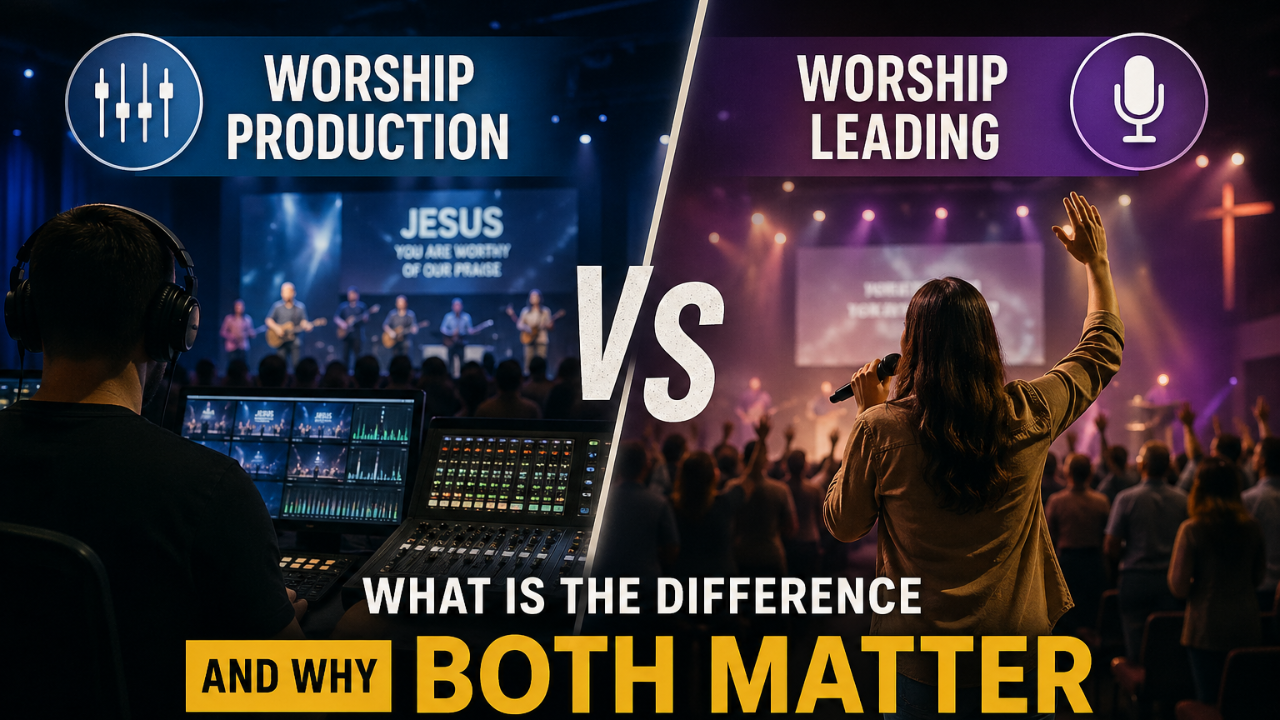
Worship Production vs Worship Leading: What’s the Difference?
Apr 27, 2026Big and small-sized churches experience this. Although it might be more persistent in smaller churches. So the worship leader is deep in a moment. The congregation is engaged. Then the wrong slide appears on the screen. The moment breaks, and what was building in the room suddenly resets.
Afterward, the production team gets the blame. When this happens, these are the questions to ponder on: Was the change communicated? Did the team know what was coming? Most times, they didn’t.
The common problem that this usually comes down to is no clear distinction between worship leading and worship production. And of course, when those roles are not clearly defined, both teams struggle, and the service suffers.
In this article, we’ll break down what each role actually involves. We'll explain how they differ. And how your church can align both to create a clear, distraction-free worship experience.
What Is Worship Leading?
When you hear of worship leading, the first thing you think of is who controls the songs, the praises, and how they flow. Worship leading is the spiritual and musical direction of a service. It is the responsibility of guiding the congregation through moments of praise, reflection, and response.
They decide how the service flows in real time. That includes knowing when to repeat a chorus, when to pause, when to transition, and when to stay in a moment longer than planned. These are not technical decisions. They are leadership decisions.
A worship leader is constantly reading the room and responding.
Their responsibilities typically include:
- Selecting and arranging the setlist for the service
- Leading the congregation musically and spiritually
- Making real-time decisions during worship
- Communicating the flow of the service to the team
The worship leader sets the tone of the service. But they cannot carry that tone alone. For the congregation to fully engage, everything around them must support what is happening on stage. That is where worship production comes in.
What Is Worship Production?
Worship production is everything that supports the worship experience from a technical standpoint. It is what makes it possible for people to clearly hear, see, and stay engaged during a service.
While the worship leader is guiding the moment, the production team is responsible for delivering that moment to the room. This includes audio, visuals, lighting, and livestream.
Let’s break that down properly:
The audio team is responsible for making sure every voice and instrument is clear. They manage microphones, balance sound levels, and ensure the lead vocal is always understandable. If the sound is not clear, people struggle to follow the worship no matter how strong the leadership is.
The visuals team handles what people see on the screen. This includes lyrics, scriptures, and any visual elements displayed during the service. Whether it is projection or LED walls for churches, timing is critical. If the lyrics are late, wrong, or hard to read, people disengage quickly.
Lighting plays a different role. It does not lead the service, but it supports the atmosphere. Changes in brightness, color, and focus help reinforce what is happening on stage, whether the moment is energetic or reflective.
Then there is the livestream and camera team. They ensure that people watching online can see and hear the service clearly. Without this, your online audience becomes disconnected from what is happening in the room.
The worship production team is responsible for:
- Running church audio systems so everything is heard clearly
- Managing screens and LED displays for worship so visuals are easy to follow
- Operating worship lighting systems to support the atmosphere
- Handling church camera systems and livestream
- Responding in real time to what is happening on stage
Where the Confusion Comes From Between a Worship Leading and Production
The confusion between these roles usually starts in smaller churches, where one person is handling multiple responsibilities.
The worship leader may also be running sound. A musician may be switching slides. A volunteer at the back may be controlling both audio and lighting at the same time.
When roles overlap like this, clarity disappears.
Even in churches with separate teams, the problem still shows up in a different way. The worship leader assumes the production team already knows what is coming next. The production team waits for direction that is never clearly given.
Both sides are doing their best. But they are not working from the same plan.
That lack of structure is what leads to mistakes, tension, and frustration during services.
Why Worship Leading and Worship Production Need Each Other
As mentioned earlier, the worship leader sets the tone. The production team carries that tone to the room.
These roles are not competing. They are connected. If the worship leader is strong but the sound is unclear, the congregation struggles to engage. If the lyrics are missing or delayed, people cannot follow. If the lighting feels disconnected, the atmosphere falls flat.
On the other hand, a strong production team without clear leadership has no direction to follow. They are reacting instead of supporting.
This is why churches that want consistency invest in both people and systems.
It is also why church AVL integration matters. When audio, visuals, lighting, and video systems are designed to work together, it becomes much easier for both teams to stay aligned and support the same goal.

What It Looks Like When Both Roles Work Well Together
Now picture a different kind of Sunday. The worship leader shares the setlist ahead of time. The production team knows the flow of the service. There is clear communication about possible changes or spontaneous moments.
When the service begins, everything works together. The lyrics follow smoothly. The sound is balanced. The lighting supports the moment without distraction. The livestream is clear and stable.
No one is scrambling. No one is guessing. And the congregation is not thinking about any of it.
They are focused on worship. That is what strong worship production systems for churches are designed to do. When everything is working well, it becomes invisible.
How to Strengthen Both Worship Leading and Worship Production Roles in Your Church
If your church is dealing with confusion or inconsistency, the solution is not complicated, but it does require intention.
Start by defining roles clearly. Even if one person handles multiple responsibilities, it helps to write down what belongs to worship leading and what belongs to worship production. Clarity removes confusion before it shows up on Sunday.
Next, invest in both sides of the team. Training should not stop with musicians and vocalists. The people running sound, visuals, and lighting are just as important. This is a key part of worship team development, and it directly affects the quality of your services.
Finally, build a simple communication system. The worship leader should not walk into a service without briefing the production team. And the production team should not be running a service without knowing the plan. When communication improves, execution improves.
When this is supported by properly designed systems like AVL integration for churches, coordination becomes much easier and more consistent.
In Summary…
Worship production and worship leading are different roles, but they serve the same purpose.
Worship leading provides direction. Worship production provides the environment that makes that direction clear.
When both roles are understood, defined, and aligned, services become smoother, teams become more confident, and the congregation can stay focused on worship without distraction.
Ready to Improve Your Worship Production and Team Structure?
If your church is dealing with unclear sound, inconsistent visuals, poor lighting, or a disconnected livestream, the issue is often not just equipment. It is how everything works together.
At Sound of Heaven, we help churches build complete worship production systems, including:
- AVL integration (audio, visuals, lighting, and cameras)
- LED walls for churches and worship stages
- Clear, reliable church production solutions
- Support for stronger, more aligned teams
If you want your services to flow better and your team to operate with clarity, the next step is a conversation.
Book a free consultation and we will walk through your current setup, your team structure, and what needs to improve.
Don't miss a beat!
New moves, motivation, and classes delivered to your inbox.
We hate SPAM. We will never sell your information, for any reason.