
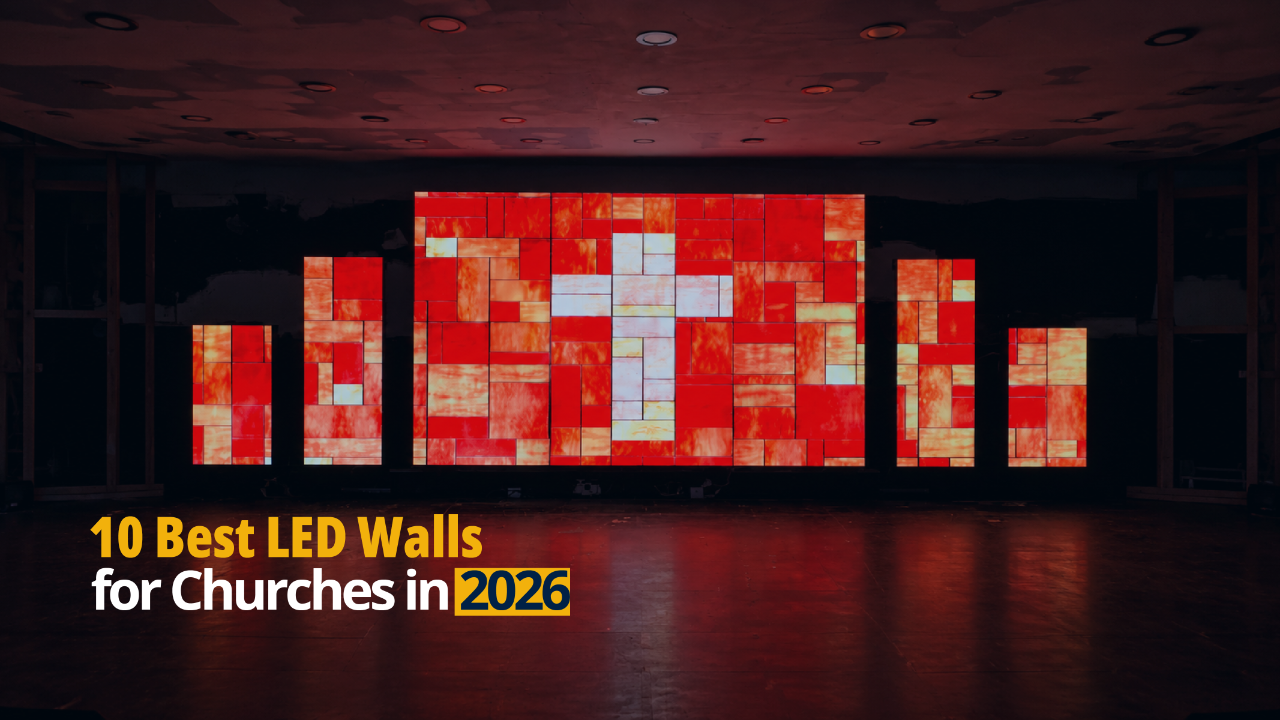
10 Best LED Wall Options for Churches
Sep 12, 2026Choosing LED walls for churches is about more than finding a screen that looks impressive.
The right LED wall should fit your sanctuary, stage, viewing distance, worship style, production setup, and long-term plans. A large church with thousands of seats may need a very different solution from a growing church meeting in a smaller space.
You also have to think beyond the display itself. How will your congregation see lyrics and Scripture? Will your production team use the wall for video and worship visuals? Will cameras capture the screen during livestreams? Can your team operate the system without creating unnecessary complexity?
With so many LED wall options available, knowing where to start can be difficult.
That's why we've put together this guide to 10 of the best LED wall options for churches. Rather than focusing only on brands or price, we'll look at the features and applications that matter most in a worship environment.
10 Best LED Wall Options for Churches
There isn't one best LED wall option that works for every church. The best choice depends on your sanctuary, viewing distance, stage design, production needs, and how you plan to use the display.
For that reason, we're looking beyond brand names alone and considering the types of LED wall solutions that can serve different church environments.
1. Fine-Pitch LED Walls for Close Viewing
Best for: Churches where the congregation sits relatively close to the LED wall.
When people are seated close to the screen, the details of an LED display become much easier to notice. That's where a fine-pitch LED wall can make a difference.
Pixel pitch refers to the distance between the individual LED pixels on a display. A smaller pixel pitch generally produces a denser, more detailed image, which can be especially useful when the audience is close to the screen.
For churches, this can be valuable when the LED wall is being used to display lyrics, Scripture, sermon graphics, camera feeds, and detailed worship visuals.
However, a smaller pixel pitch isn't automatically better for every church. If your congregation sits far away from the stage, you may not need to invest in the finer pitch that close viewing requires.
Best suited for: Smaller sanctuaries, intimate worship spaces, and churches where the audience is positioned relatively close to the stage.
2. Modular LED Walls for Flexible Stage Designs
Best for: Churches that want flexibility in how their LED wall is configured.
Modular LED walls are built from individual panels that can be assembled into larger displays. This gives churches more flexibility than treating the LED wall as one fixed screen.
Depending on the system and installation, modular panels can support different screen dimensions and stage configurations. That can be useful for churches that want a large central display, multiple sections, or a design that works around other elements of the stage.
This flexibility also makes modular LED technology worth considering for churches that expect their worship space or production needs to evolve over time.
Best suited for: Churches with changing stage designs, growing production needs, or a desire for more configuration flexibility.
3. High-Brightness LED Walls for Bright Worship Environments
Best for: Churches where ambient or stage lighting can make displays difficult to see.
An LED wall needs to remain visible under the lighting conditions in which it will be used.
A sanctuary with strong stage lighting, large windows, or significant ambient light may require a display with sufficient brightness to maintain visibility. This is particularly important when the screen is being used for lyrics, Scripture, video, or live camera feeds.
The goal isn't simply to choose the brightest display available. Excessive brightness can also make a screen uncomfortable to look at. What matters is finding a display that works appropriately with the church's lighting environment.
Best suited for: Bright sanctuaries, stages with intensive lighting, and spaces with significant ambient light.
4. Camera-Friendly LED Walls for Livestreaming
Best for: Churches where the LED wall is an important part of the livestream production.
Your congregation isn't the only audience watching your LED wall.
If your church livestreams its services, cameras will capture the display as part of the production. That means refresh rate, image consistency, color reproduction, and overall display performance can affect what viewers see online.
A camera-friendly LED wall can help your production team create cleaner shots without the visual problems that can occur when a display isn't well suited to camera capture.
This makes camera performance an important consideration for churches that see livestreaming as a major part of their ministry and communications strategy.
Best suited for: churches with livestreams, broadcast-style production, or multiple camera angles focused on the stage.
|
Not sure which LED wall fits your church? Every sanctuary is different. Book a free consultation and get a clear, no-pressure recommendation for your space, stage, and budget. |
5. Fine-Pitch COB LED Walls
Best for: Churches looking for high-detail LED displays in environments where close viewing and image quality are priorities.
COB, or Chip-on-Board, is an LED display technology designed to package LED chips more closely together on the display surface.
For churches, COB displays can be worth considering when the LED wall will be viewed from relatively short distances and when image quality and durability are important considerations.
As with any LED technology, though, the technology itself shouldn't be the only deciding factor. Churches should still consider viewing distance, installation requirements, production workflow, maintenance, and budget before choosing a COB solution.
Best suited for: Churches prioritizing fine detail, close viewing, and premium display performance.
6. Large-Format LED Walls for Large Sanctuaries
Best for: Churches with large worship spaces and long viewing distances.
A large sanctuary creates a different challenge: everyone needs to be able to see what's happening on the screen.
A larger LED wall can help provide a clear visual reference for congregations spread across a wide seating area. It can also become a major part of the stage design, supporting lyrics, Scripture, sermon content, video, and worship visuals.
But bigger isn't always better.
The display still needs to be appropriately sized for the stage and viewing environment. A church should consider the relationship between screen size, seating distance, stage dimensions, and sightlines before deciding how large the wall should be.
Best suited for: Large churches, large sanctuaries, conference spaces, and worship environments with long viewing distances.
7. Curved LED Walls for Creative Stage Designs
Best for: Churches that want their LED display to become part of the stage architecture.
Not every LED wall has to be completely flat.
Curved configurations can create a more immersive visual environment and allow churches to incorporate the display into more creative stage designs.
They can be particularly interesting for worship environments where visual storytelling and stage design are important parts of the production.
However, curved configurations can introduce additional planning considerations. The church needs to consider how the display will be mounted, configured, operated, and maintained before committing to the design.
Best suited for: Churches with creative stage designs, large production teams, and environments where the LED wall is intended to be a major visual feature.
8. Portable LED Wall Solutions
Best for: Churches that need an LED display they can use across different locations or events.
Some churches don't have a single permanent worship environment.
They may host conferences, outdoor services, special events, youth programs, or worship gatherings in different spaces. A portable or mobile LED wall can provide greater flexibility in those situations.
The trade-off is that portability introduces additional considerations around transportation, setup, storage, structural support, and operation.
For a church that regularly moves its production equipment, however, that flexibility can be valuable.
Best suited for: Multi-location churches, event-driven ministries, churches that host services outside their primary sanctuary, and mobile production teams.
9. Indoor LED Walls Designed for Worship Spaces
Best for: Churches installing a permanent LED wall inside a sanctuary.
Indoor LED walls are designed specifically for controlled indoor environments and are often a natural fit for permanent church installations.
A well-selected indoor display can support the everyday needs of a worship service, from lyrics and Scripture to video playback, live camera feeds, sermon graphics, and other visual content.
The important thing is to match the display to the actual room rather than choosing an indoor LED wall based solely on its specifications.
Consider the sanctuary's lighting, viewing distance, stage dimensions, content requirements, and existing production system before making a decision.
Best suited for: Churches looking for a permanent LED installation inside a sanctuary or worship facility.
10. Integrated LED Wall Solutions for Complete Church Production Systems
Best for: Churches planning an LED wall as part of a larger production upgrade.
An LED wall doesn't operate in isolation.
It can become part of a larger system that includes cameras, video switchers, presentation software, livestreaming equipment, audio, lighting, and other production technologies.
That's why some churches may benefit from approaching an LED wall as part of their overall AVL system rather than buying the display separately.
For example, Sound of Heaven's approach to AVL integration considers how the different parts of a church's production environment work together. This can help churches avoid ending up with an impressive LED wall that doesn't integrate smoothly with the rest of their workflow.
Best suited for: Churches undertaking a broader production upgrade or building a new worship production system from the ground up.
How to Choose the Right LED Wall Option for Your Church
With several LED wall options available, the goal isn't to find the display with the longest list of features. It's to find the one that makes sense for your church's space, production needs, and future plans.
Before making a decision, consider these questions:
How far will people be sitting from the LED wall?
Your viewing distance can influence the pixel pitch and level of detail you need, based on the pixel pitch and viewing distance guidance from AVIXA, the trade association for the AV industry. A display designed for close viewing may make more sense in a smaller sanctuary, while a large worship space may require a different configuration.
How will your church use the LED wall?
Will it primarily display lyrics and Scripture, or will your team also use it for sermon graphics, videos, camera feeds, worship backgrounds, and livestream production? The more demanding your content and production workflow, the more carefully you should evaluate the display's performance.
Does it work with your existing production system?
Think about the equipment and software your church already uses or plans to use. Your LED wall may need to work alongside presentation software such as ProPresenter, video switchers, cameras, and livestreaming equipment. A display that looks great on its own may still create problems if it doesn't fit into your broader production workflow.
What does your stage actually need?
Before choosing a size or configuration, look at the stage itself. Consider your sightlines, existing equipment, stage design, lighting positions, and the space available for installation. The LED wall should complement the stage rather than overwhelm it.
Who will install and support it?
An LED wall is a significant investment, so don't stop your evaluation at the product specifications. Ask who will handle installation, configuration, maintenance, troubleshooting, and future upgrades. Having the right support can be just as important as choosing the right display. Our free worship community is also a good place for worship teams to compare notes on what's worked in their own church builds.
Ultimately, the best LED wall option is the one that fits your church, not simply the one with the most impressive specifications.
Frequently Asked Question on Best LED Wall Options for Churches
What's the difference between pixel pitch and resolution on a church LED wall?
Pixel pitch is the physical distance between individual LED pixels, measured in millimeters. Resolution is the total number of pixels the display can show. The two are related but not the same: a smaller pixel pitch generally allows for higher resolution at a given screen size, which is why pixel pitch is one of the first specs to evaluate when comparing options.
How close can my congregation sit to an LED wall before it looks pixelated?
Industry guidance from AVIXA offers a simple starting point sometimes called the 10x rule: multiply the pixel pitch in millimeters by roughly 10 to estimate the minimum comfortable viewing distance in feet. A 2 mm pitch wall, for example, looks smooth from about 20 feet back. It's a planning estimate, not an exact figure, since lighting, content, and individual eyesight all play a role.
Do I need a fine-pitch display if my sanctuary is small?
Not necessarily, but it's worth considering. If your congregation sits close to the stage, a fine-pitch display keeps lyrics, Scripture, and camera feeds looking sharp instead of blocky. If most seating is farther back, a wider pixel pitch can deliver the same visual quality for less cost.
Can an LED wall work with ProPresenter and my existing production software?
Most modern LED walls are designed to integrate with standard church production software, including ProPresenter, along with common video switchers and camera systems. The key is confirming compatibility and signal requirements before installation, which is one of the reasons an integrated AVL approach tends to prevent compatibility issues down the line.
Should I choose a portable or a permanent LED wall for my church?
It depends on how your church uses its worship space. A permanent indoor LED wall makes sense for a single sanctuary used every week. A portable or modular option is worth considering if your church regularly hosts events, outdoor services, or worship gatherings in more than one location.
|
Ready to find the right LED wall for your sanctuary? Talk with our team about your space, your budget, and your production goals. We'll walk you through the options and help you choose with confidence. |
Don't miss a beat!
New moves, motivation, and classes delivered to your inbox.
We hate SPAM. We will never sell your information, for any reason.