
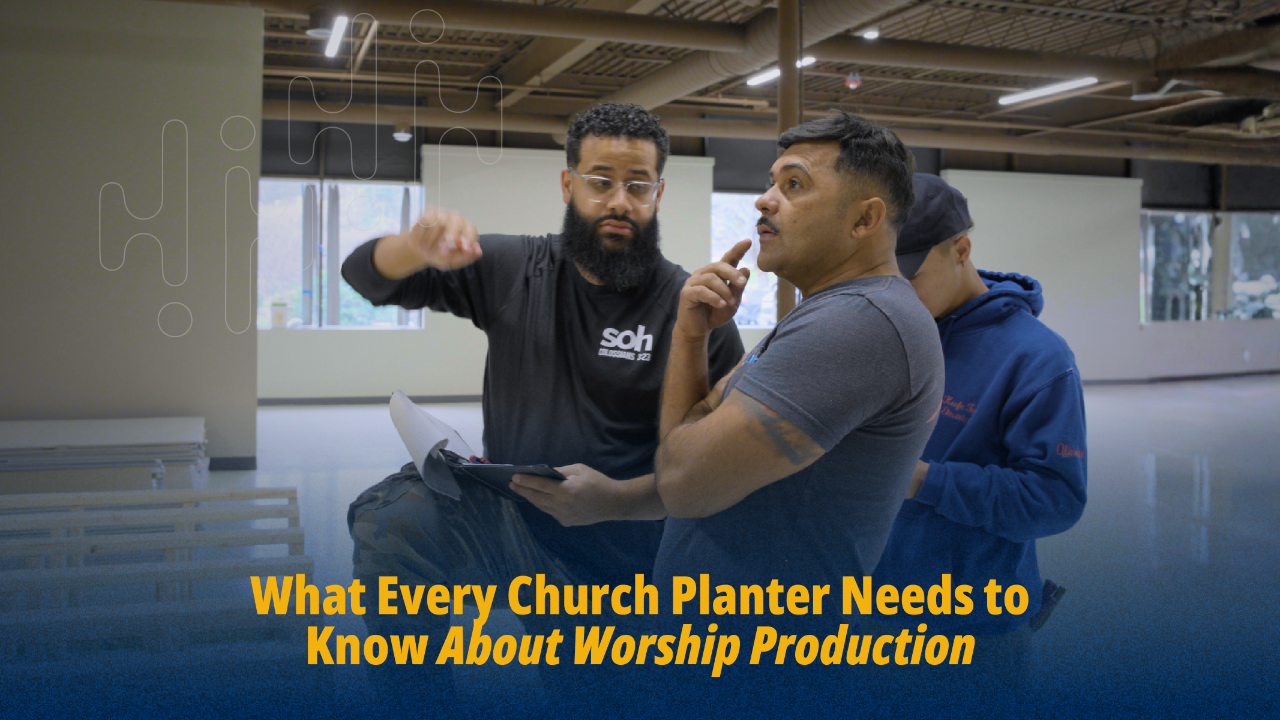
What Every Church Planter Needs to Know About Worship Production
Jun 25, 2026Reading Time: 7 minutes
Bad sound has ended more first visits than bad theology.
That's not an exaggeration. A first-time guest who can't hear the pastor clearly, who sits in a room that feels dim and uninviting, or who watches a livestream that drops every few minutes will not come back. Not because they didn't feel welcomed. Because the environment told them something before anyone said a word.
Church planters know this on some level. But most are so focused on the spiritual and relational side of launching a church that production gets pushed to the bottom of the list. It gets handled with whatever is left in the budget, by whoever is willing to volunteer, with equipment bought from wherever was cheapest.
If you're planting a church anywhere in the U.S. right now, this guide is for you. Church planting production support is not a luxury conversation. It's a foundational one. And the earlier you have it, the better your church launch will go.
Why Worship Production Matters More Than Church Planters Expect
Most church planters think about production last. That's understandable. You're focused on people, prayer, and purpose. Equipment feels secondary.
But here's what nobody tells you. Your production environment is the first thing a first-time visitor experiences before you say a word.
Before the sermon. Before the welcome. Before worship even starts. People feel the room. They hear the sound. They notice whether the space feels prepared or thrown together.
Poor audio tells a visitor your church isn't ready. Bad lighting makes your stage feel cold and uninviting. A video feed that drops in and out signals that your team is overwhelmed.
None of that is about impressing people. It's about removing barriers between your congregation and genuine worship.
When people can clearly hear the Word, clearly see the stage, and feel the atmosphere of a room that was intentionally prepared, they can focus on what they came for. An encounter with God.
That's what worship production is really about. Not technology. Not budgets. Removing distractions so people can connect.
If you're new to the concept of how all of this works together, start here: What Is a Worship Production System? A Complete Guide for Churches.
What Worship Production Setup Does a New Church Actually Need?
This is a breakdown of the worship production set up that a new church actually need:
-
Audio First. Always.
Sound is the most important element in any worship environment. People will forgive a lot. They will not forgive not being able to hear the pastor or the worship team clearly.
Start with a solid audio foundation. A quality mixing console, reliable speakers, proper microphones, and monitors your musicians can actually hear. Get this right before anything else.
-
Lighting Second.
Lighting shapes how your space feels. A well-lit stage draws attention where it belongs. It sets the atmosphere for worship and makes your room feel intentional, not improvised.
Basic stage lighting and house lighting control will make a significant difference on a church plant budget.
-
Video and Cameras Third.
Once your sound and lighting are solid, build your video system. Start with one or two cameras that your volunteers can confidently operate. Add a simple video switcher so you can manage what the congregation sees on screen and what goes out to your livestream.
-
Display Screens or LED Wall Last.
Screens and LED walls are powerful tools for worship. But they're most effective when your audio and lighting are already working well. Build your foundation first, then add display solutions.
When you're ready to explore what an LED wall would look like for your church, our team can walk you through the options.
For a full picture of how to set up your video system alongside your display, this article covers exactly that: How to Set Up a Church Video System That Works for Livestream and In-Person.
What Are the Biggest Worship Production Mistakes New Churches Make?
Church planters are resourceful. But resourcefulness without the right information leads to expensive mistakes. These are the biggest worship production mistake we see new churches make:
-
Buying cheap gear to save money upfront.
Budget equipment feels like wisdom in the short term. But cheap mixers, speakers, and cameras break down faster, sound worse, and end up costing more when they need to be replaced in 18 months. Buy quality where it counts, especially audio.
-
Ignoring acoustics.
You can have the best speakers in the world and still have terrible sound if your room isn't acoustically treated. Hard floors, bare walls, and low ceilings create echo and muddiness that no equipment can fully fix. Acoustic treatment is an investment that makes everything else work better.
-
Building a system your volunteers can't operate.
A system your most experienced volunteer can run perfectly is useless if that volunteer isn't there one Sunday. Design your production setup so that any trained volunteer can step in and run a clean service. Simplicity is a feature, not a limitation.
-
Treating production as a one-time purchase.
Technology changes. Your church grows. What works for 50 people in a rented school auditorium won't work for 300 people in a permanent building. Plan for growth from the beginning so your system can scale with you.
-
Not testing before Sunday.
A five-minute sound check is not the same as a proper rehearsal. Test every piece of equipment. Run your livestream. Switch camera angles. If something is going to fail, you want to find out on Saturday, not Sunday morning.
For a deeper look at what goes wrong during services and how to prevent it, this is worth reading: What Causes Technical Distractions During Worship and How to Fix Them.
How Do You Build a Scalable Worship Production System on a Church Plant Budget?
Budget is real. Nobody plants a church with unlimited funds. Here's how to build smart without starting over in two years.
-
Start with what your congregation feels first
Audio is felt before it's analyzed. Invest the largest portion of your initial budget here. A congregation can worship without LED walls. They cannot worship when they can't hear.
-
Think scalable from day one.
Buy equipment that can grow with you. A mixing console with expansion slots. A camera system that lets you add more cameras later. A lighting rig that can be expanded as your room grows. Ask your production partner about scalability before you buy anything.
-
Consider renting for your launch season.
If you're in a temporary space for your first six to twelve months, renting production equipment makes more sense than buying. It keeps your costs low while you find your permanent home. Once you're in a permanent space, then you invest in ownership.
If you're mapping out a realistic budget for your production setup, this guide is a great starting point: How Small Churches Can Improve Worship Production Without a Big Budget.
You Were Called to Plant a Church. Not to Fix Cables.
The production side of ministry is real. It matters. And it deserves to be handled well.
But it doesn't have to be handled alone.
Sound of Heaven is here to walk with you from your first Sunday through every season of growth. We'll handle the production so you can stay focused on the people God has placed in your care.
The first step is a free conversation with our team. let's give you clarity on what your church needs and a realistic plan to get there.
Don't miss a beat!
New moves, motivation, and classes delivered to your inbox.
We hate SPAM. We will never sell your information, for any reason.