
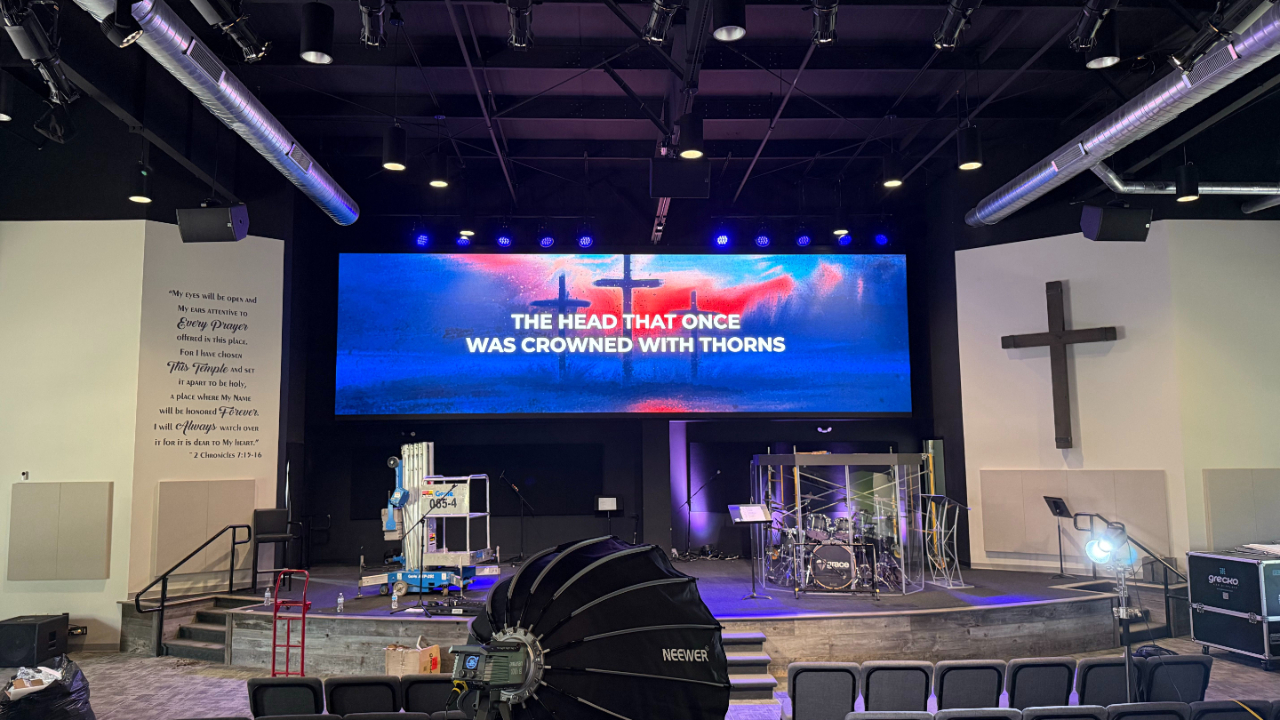
Can a Church Install an LED Wall Themselves? Comparing DIY vs Professional Installation
Mar 01, 2026If your church has been looking into LED walls, you’ve probably asked this question at some point: can we install this ourselves?
You see the panels online. You watch installation videos. A few volunteers say, “We can handle it.” On paper, it looks simple. Mount the panels, connect power, plug in your presentation computer, and you’re done.
Before you decide between DIY and professional installation, it helps to understand what’s actually involved, and when doing it yourself makes sense. You'll get all the information in this guide. Continue reading.
Why More Churches Are Considering DIY LED Walls
Anyone who has priced LED walls for churches recently already know they are not a small investment. When budgets are tight, it’s natural to look for ways to reduce costs. That’s where DIY installation starts to sound appealing. This section discusses why churches consider DIY LED Walls installation.
-
Direct-to-Church Online Suppliers
Today, many LED manufacturers sell directly online. You can compare pixel pitch options, select panel sizes, and even find installation tutorials. Because the buying process feels simple, installation can start to look simple too.
-
Skilled Volunteers Within the Church
Many churches have members who work in construction, electrical trades, or AV production. When you already rely on volunteers to run sound, lighting, and livestream each week, installing an LED option for church use can feel like a reasonable extension of those skills.
-
The Desire to Save on Labor Costs
Professional installation adds cost. For churches trying to stretch their budget, handling the mounting and setup internally may seem like a way to allocate more funds toward higher-quality panels or a larger wall size.
-
Smaller or Simpler Installations
In some cases, the setup truly is straightforward. A smaller LED wall with basic presentation needs and minimal livestream integration may not require complex system design. For churches with strong technical leadership, DIY can sometimes work.
What Installing an LED Wall Actually Requires
Installing LED walls for churches involves far more than mounting panels and plugging in cables. Once you look closely at the full process, you begin to see how many moving parts are involved. These are some key requirements:
-
Structural Planning and Mounting
LED panels are heavy. When combined into a full wall, the total weight can be significant. That means you must evaluate the mounting surface, confirm load-bearing capacity, and design a secure framing structure. If the wall is not properly supported, alignment issues or safety risks can follow.
-
Electrical Planning and Power Distribution
LED walls draw more power than most churches expect. Dedicated circuits, clean power distribution, and proper grounding are necessary to prevent overloads or inconsistent brightness. Electrical planning must be done carefully to avoid long-term reliability problems.
-
Pixel Pitch Selection and Viewing Distance
Choosing the right LED option for church use is not just about size. Pixel pitch — the distance between individual pixels — directly affects clarity. A smaller pitch works better for closer seating, while a larger pitch may suit bigger rooms with greater viewing distance. Selecting the wrong pitch can either reduce clarity or increase cost unnecessarily.
-
Panel Calibration and Processor Configuration
Even after mounting, the work is not finished. Panels must be aligned, brightness balanced, and colors matched to ensure a seamless image. The LED processor must also be configured correctly so that lyrics, sermon slides, and videos display at the proper resolution without distortion.
-
Integration With Worship and Livestream Systems
Finally, the LED wall must work with your presentation software, cameras, and livestream setup. Brightness levels must be tested with cameras running. Inputs must be configured properly. The system should be tested under real service conditions, not just with a test image.
When you add all of this together, installing LED walls for churches becomes less about “putting up a screen” and more about designing a complete visual system.
Now you see that the concern is not whether installation is possible. It’s whether your team has the time, skill, and margin to manage every one of these steps confidently.
When DIY LED Wall Installation Might Make Sense
There are situations where installing an LED wall yourself can be reasonable. Not every church requires a large, complex system, and not every installation carries the same level of risk. They are discussed below:
-
You Have Verified Technical Expertise
If your church has licensed electricians, experienced AV technicians, or professionals who regularly work with structural installations, DIY becomes more realistic. The key is not enthusiasm, it’s proven skill and real-world experience.
-
The LED Wall Is Small and Straightforward
A smaller LED wall with basic presentation needs is far less complex than a full-stage backdrop. If your setup does not require advanced processor configuration, multiple video inputs, or livestream optimization, the scope is naturally reduced.
-
Livestream Integration Is Minimal
If your church does not run a complex broadcast setup, and the LED wall is mainly for in-room lyrics and sermon slides, the integration process becomes simpler. Fewer system connections reduce the margin for error.
-
You Understand Warranty and Risk
Some LED manufacturers provide limited support for self-installed systems. If your team clearly understands what is covered, what is not, and how future servicing will work, DIY may be manageable.
-
You Have Time for Testing and Adjustment
DIY installation takes time, often more than expected. If your church can install, test, recalibrate, and refine the system without rushing toward Sunday, you reduce the risk of visible issues during services.
In short, DIY can make sense when the system is simple, the expertise is real, and the risks are fully understood.
But once complexity increases, larger walls, tighter viewing distances, heavy livestream integration, the margin for error becomes smaller.
Where DIY Installation Becomes Risky
DIY installation becomes risky when the system moves beyond basic mounting and enters structural, electrical, and integration complexity.
-
Structural and Safety Risks
LED walls are heavy, and improper mounting can lead to alignment issues or long-term structural stress. If load calculations are incorrect or framing is insufficient, the problem may not appear immediately, but it can develop over time.
-
Power and Electrical Miscalculations
Underestimating power requirements is common. Without dedicated circuits and proper distribution, you may experience breaker trips, inconsistent brightness, or long-term electrical strain. These issues often show up during high-demand services when everything is running at full intensity.
-
Incorrect Pixel Pitch Selection
Choosing the wrong pixel pitch for your sanctuary size can affect clarity. If seating is close and the pitch is too large, text may appear grainy. If seating is far and the pitch is unnecessarily small, costs increase without visible benefit.
-
Calibration and Visual Inconsistencies
Even if panels are mounted correctly, improper calibration can lead to visible seams, uneven brightness, or color shifts. These issues are subtle but noticeable, especially during livestream where cameras amplify visual imperfections.
-
Livestream and Camera Conflicts
LED brightness and refresh settings must be tested with cameras running. If not configured properly, you may see flickering, banding, or exposure issues online. What looks acceptable in the room may not translate well to broadcast.
-
Limited Long-Term Support
If problems arise later, DIY installations often rely on manufacturer support alone. Without a professional integrator involved, troubleshooting can take longer and may require outside service anyway.
As system size, integration depth, and technical demands increase, the margin for error decreases. What begins as a cost-saving decision can eventually require corrective work.
DIY vs Professional Installation: How Should a Church Decide?
With everything said so far, be reminded that DIY installation may reduce upfront labor costs. But it increases responsibility for structural safety, electrical accuracy, calibration precision, and long-term troubleshooting. If your team has proven expertise, adequate time, and a simple system design, self-installation can work.
Professional installation shifts that responsibility to specialists. It ensures proper mounting, correct pixel pitch selection based on viewing distance, full calibration, and seamless integration with your worship and livestream systems. It also provides structured support if issues arise later.
The real comparison often comes down to three factors:
- Risk tolerance — Are you comfortable managing structural and electrical complexity internally?
- Technical depth — Does your team truly understand processor configuration, calibration, and camera integration?
- Long-term stability — Do you want a system that simply works each Sunday without constant adjustments?
For many churches, LED walls are not small purchases. They represent a major investment in clarity, communication, and worship experience. When complexity increases — larger wall sizes, tighter viewing distances, full-stage backdrops, or livestream-heavy environments — professional turnkey installation provides stability that DIY often cannot.
Conclusion
Installing LED walls for churches is possible to do yourself — but it is not always simple. As wall size, pixel pitch decisions, structural weight, and livestream integration increase, so does the level of responsibility and risk.
If your church wants a system that is structurally secure, properly calibrated, and fully integrated with your worship production, Sound of Heaven provides complete turnkey LED wall installations designed specifically for ministry environments. Schedule a Free Worship Production Consultation and let us help you choose the right LED option for your church with clarity and confidence
Looking for an LED Installation Professional?
At Sound of Heaven, we design and install LED walls for churches with full structural planning, proper pixel pitch evaluation, precise calibration, and complete AVL integration. Our goal is not just to mount panels, but to deliver systems that work consistently week after week.
If your church is considering an LED wall, schedule a Free Worship Production Consultation. We will help you evaluate whether DIY makes sense for your space — or design a turnkey solution that removes uncertainty altogether.
The right LED option for your church is not just about cost. It is about clarity, safety, and confidence every Sunday.
Don't miss a beat!
New moves, motivation, and classes delivered to your inbox.
We hate SPAM. We will never sell your information, for any reason.